Cycles Overview
What is a cycle?
A Cycle is an electronic file that contains all the items relating to a specific Sponsored Project during a specific competing segment. Cycles are a convenient mechanism for tracking the progression of a competing segment and the relationship of the items created within that segment.
Here’s an example of what a Cycle might contain:
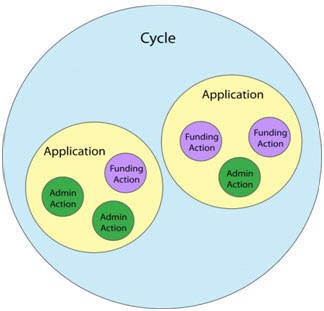
You can relate a cycle to another cycle. For example, you might want to relate cycles for a project with multiple competing segments.
How is the cycle organized?
We often refer to the relationship of two items as “parent” and “child.” A “parent” item might be the cycle, an application, or an action and its “child” might be an application or another action.
The Cycle is the top of the hierarchy and so it has no parent. Cycles contain three possible child items: NAA, PAN, and eGC1.
Some parent-child relationships are specifically defined, while others are more general. The following table indicates the typical relationships between items.
| Item Type | Parent | Children |
| Cycle | (none) | NAA, PAN, eGC1 |
| eGC1 | Cycle [1] | FA, NAA, CO, AA, ADV |
| PAN | Cycle [2] | (none) |
| FA | eGC1 [3] | PAC, SC |
| PAC | FA | (none) |
| NAA | Cycle, eGC1, or FA | (none) |
| CO | eGC15 | (none) |
| AA | Cycle, eGC1, or FA | (none) |
| SC (subcontract) | FA | (none) |
| ADV (advance budget number request) | eGC1 | (none) |
Table Notes: Currently, the system also allows
- An eGC1 to be the child of another eGC1.
- A PAN to be the child of an eGC1 or an FA.
- A CO to be the child of a Cycle, eGC1, or an FA.
Applications (eGC1s) within the cycle display from newest to oldest. Child items under eGC1s display oldest to newest.
Tips:
- When you click “Back to My Team” from the Cycle Details page, the Cycle Details window will close, and the window you last had open will revert to the My Team tasklist. If you wish to keep your previous item open, close the browser tab containing the Cycle Details (rather than clicking the “Back to My Team” link).
- You can only use the Cycle Details tab or “fly-out menu” to open one other item at a time. If you want to open multiple cycle items at a time, then do so from the Cycle Details page.