A Preliminary Report of the AccessSTEM/DO-IT Longitudinal Transition Study (ALTS)
by S. Burgstahler, University of Washington, and C. Chang, University of Hawaii at Manoa
Reporting data as of May, 2007. Some data updated March, 2008.
A longitudinal transition study sponsored by AccessSTEM/DO-IT explores college and career outcomes for students with disabilities participating in activities sponsored by DO-IT projects funded by the National Science Foundation and the state of Washington. Specific research questions are:
- (a) What are the educational achievements of participants in AccessSTEM/DO-IT interventions? (b) Do they differ from other youth with disabilities with regard to educational achievements?
- (a) What are the employment outcomes of participants in AccessSTEM/DO-IT interventions? (b) Do they differ from other youth with disabilities with regard to employment achievements?
- Are specific interventions, such as summer college/career preparation programs, mentoring, and internships, positively correlated with better academic and employment outcomes of program participants?
Because of the goal of AccessSTEM to increase the numbers of STEM (science, technology, engineering, and mathematics) postsecondary degrees and careers for individuals with disabilities, in addressing each of the research questions specific data is collected and analyzed regarding STEM activities, education, and employment. The AccessSTEM/DO-IT Longitudinal Transition Study (ALTS) measures progress toward STEM degrees/careers of students with disabilities who had a goal of postsecondary education while in high school and received DO-IT-funded interventions (e.g., internships, mentoring, college transition activities), many of which were funded by NSF.
The study is designed in such a way that respondent content can be updated and data can be analyzed at any point. Recognizing that at any point in time some respondents in the study are still enrolled in secondary school or are recent high school graduates, besides graduation and career outcome data, the researchers record the "on track" status of respondents as they progress through critical junctures that lead to degrees and careers in STEM. The reports of ALTS respondents are compared with those of participants in the National Longitudinal Transition Study (NLTS) for whom postsecondary education was part of their transition plan while they were still in high school. Although ALTS participants were not randomly selected and the two groups are not identical in characteristics, both groups are composed of college-bound youth with a wide range of disabilities. Neither group was recruited because of STEM interest; DO-IT, for example, works with students who have a wide variety of academic interests, but encourages and supports STEM studies and career pursuits through program activities and resources. The ALTS Logic Model provides a visual representation of activities in which respondents were involved as well as project outputs, goals/outcomes, and long-term impacts.
The AccessSTEM/DO-IT Longitudinal Transition Study is supported through a cooperative agreement with the National Science Foundation (NSF, HRD#0227995); The DO-IT Scholars program, in which many study respondents participated, has been primarily funded by the National Science Foundation and the state of Washington since 1992.
Results of the ongoing ALTS are useful to those who wish to undertake or fund projects designed to increase the college and career success of individuals with disabilities, particularly in STEM fields. It addresses the recommendation of The Committee on Equal Opportunities in Science and Engineering (2004) that the NSF make an effort to collect more and higher-quality data about factors that promote the success of individuals with disabilities in STEM fields.
Recruited through their participation in DO-IT activities, respondents in this study were interviewed in person, by email, by phone, or in a combination of ways. Their records were added to an online database. Content stored in the database includes demographics, assistive technology usage, involvement in program activities, stages of progress through critical junctures leading to STEM careers, participants' reasons for discontinuing progress toward a STEM career, and career outcomes. Participants are periodically interviewed to update database content. ALTS data is analyzed by the AccessSTEM external evaluator.
The following paragraphs provide a brief overview of some of the data being collected in the ongoing AccessSTEM/DO-IT Longitudinal Transition Study.
Demographics
As of May 2007, the study included a total of 171 respondents. Fifty-three percent of the respondents are male; 47% are female; their mean age was 22 years (SD = 5.83) at the time of their first interview. A majority of respondents are:
- Caucasian (75%), followed by
- "Other", consisting of Asian Indian, Hispanic White, Guatemalan, and people of mixed races (7.6%);
- Asian American and Pacific Islander (5.8%);
- Hispanic (4%),
- Black (3%); and
- American Indian (2.3%).
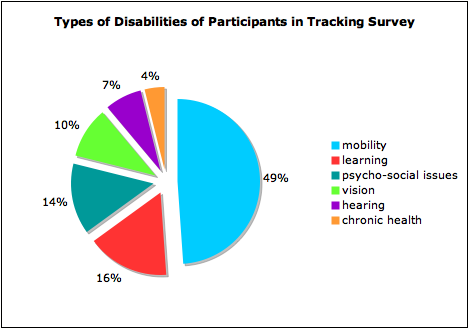
Reported disabilities are related to:
- mobility (49%),
- learning (16%),
- psycho-social issues (14%),
- vision (10%),
- hearing (7%),
- and chronic health (4%).
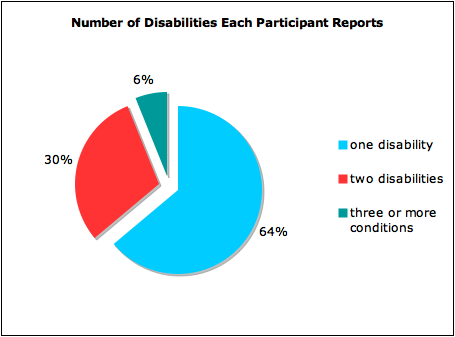
Respondents reported having:
- one disability (64%),
- two disabilities (30%),
- and three or more conditions (6%).
Two (1.2%) began participation in DO-IT activities in middle school, 138 (82.1%) in high school, 24 (14.3%) as college undergraduates, 2 (1.2%) as graduate students, and 2 (1.2%) when seeking employment.
Program Participation and Value of Interventions
Respondents participated in the following evidence-based practices.
- Technology access. Ninety-eight percent and 82% of the respondents had access to a computer and the Internet, respectively, before they participated in program activities. The percentage of computer and Internet access increased to 100% and 96%, respectively, after program participation.
However, the proportion of the respondents who had access to adaptive software or hardware was quite low (29%) before participation, but very high (62%) after participation in program activities. Adaptive software and hardware provided to some participants through the program included scanning/reading, word prediction, mind mapping/outlining, speech recognition, and screen magnification software; alternative keyboards and mice. Participant results can be compared to findings of The Children's Partnership where in a survey of individuals 15 years and older, only 44% with disabilities had a computer at home, compared to 72% of those without disabilities; only 38% of those with disabilities had access to the Internet at home, compared to 64% of those without disabilities; and only 24.3% of those with disabilities use the Internet at home, compared to 50.5% of those without disabilities.
- Internships and Other Work-Based Learning. Thirty-five percent of respondents completed at least one internship, with the total number of internships completed by each respondent ranging from one to five.
- Mentoring. Ninety-six percent of the respondents reported having access to mentors during program participation (the remaining 4% of the participants had not yet been paired with mentors because they had just joined the program), up from 33% before participation.
- College and Career Transition Workshops/Camps. Approximately one third of the respondents participated in college and career transition workshops or camps.
- Non-DO-IT STEM Activities. In addition to the aforementioned experiences provided through DO-IT, one third of the respondents were involved in extracurricular STEM service groups, clubs, or other activities.
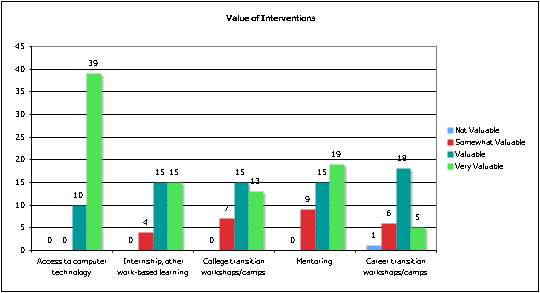
The following table summarizes respondent perceptions regarding the value of program activities as they prepared for college and careers, in order from most to least valued as indicated by the proportion of "valuable" and "very valuable" ratings.
| Program Activities | Not Valuable | Somewhat Valuable | Valuable | Very Valuable |
|---|---|---|---|---|
| Access to computer technology | 0.0% (0) | 0.0% (0) | 20.4% (10) | 79.6% (39) |
| Internship, other work-based learning | 0.0% (0) | 11.87% (4) | 44.1% (15) | 44.1% (15) |
| College transition workshops/camps | 0.0% (0) | 20.0% (7) | 42.9% (15) | 37.1% (13) |
| Mentoring | 0.0% (0) | 20.9% (9) | 34.9% (15) | 44.2% (19) |
| Career transition workshops/camps | 3.3% (1) | 20.0% (6) | 60.0% (18) | 16.7% (5) |
The nine DO-IT staff members who work the most on multiple activities with DO-IT participants were also asked to rate the value of these program activities. The results, with activities listed in the same order as above, are:
| Program Activities | Not Valuable | Somewhat Valuable | Valuable | Very Valuable |
|---|---|---|---|---|
| Note that participants and staff rated all interventions highly; even the lowest rated item, "Career transition workshops/camps" was rated "valuable" or "very valuable" by 76.7% and 88.9% of the participants and staff, respectively. All participants and staff gave "Access to computer technology" "valuable" or "very valuable" ratings. | ||||
| Access to computer technology | 0.0% (0) | 0.0% (0) | 33.3% (3) | 66.7% (6) |
| Internship, other work-based learning | 0.0% (0) | 0.0% (0) | 22.2% (2) | 77.8% (7) |
| Mentoring | 0.0% (0) | 0.0% (0) | 11.1% (1) | 88.9% (8) |
| College transition workshops/camps | 0.0% (0) | 0.0% (0) | 0.0% (0) | 100.0% (9) |
| Career transition workshops/camps | 0.0% (0) | 11.1% (1) | 33.3% (3) | 55.6% (5) |
High School Completion
At the time of their first interview, 130 of the ALTS respondents for whom data was available graduated from high school and the remainder were still in high school - an impressive 100% high school completion rate. In comparison, the rate of high school completion for youth with disabilities was 54% for 1987 and 70% for 2003 in the NLTS and the NLTS2, respectively. In a nation-wide survey of individuals with disabilities (NOD, 2004) it was found that students with disabilities drop out of high school at a rate (21%) that is double that of the general population (10%). The rate of high school completion (18- through 24-year-olds not enrolled in high school that had received a high school diploma or equivalency credential) in the general population fluctuated between 86.4 percent in 1992 and 87.6 percent in 2005 (NCES, NCES2). Among the ALTS respondents who completed high school, almost all earned a high school diploma; one completed high school by passing a General Educational Development (GED) exam as compared to the national rate of 5.1% in 2000 and 7.8% in 1998 and 1999. (NCES, 2007a,b).
Postsecondary Education Participation and Graduation
Among the 122 respondents tracked for postsecondary transitions (that did not include those still in high school or who were very recent graduates),
- 99% (121) had enrolled in college, with approximately equal proportions first attending 2-year and 4-year colleges;
- 45% (55) had earned a postsecondary certificate or degree, and
- 65% (79) were still enrolled.
- A total of 24%/48%/53% of ALTS respondents at 2-year/4-year/graduate schools majored in STEM; 45 of respondents have earned a postsecondary certificate/degree (35% in STEM).
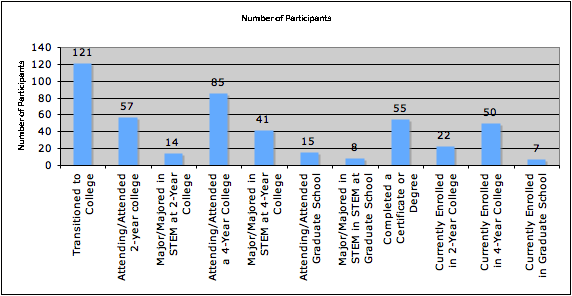
The table below provides additional data.
| Postsecondary education status | Number of participants | Percentage |
|---|---|---|
| Transitioned to College | 121 | |
| Attending/Attended 2-Year College | 57 | 46.7% of students who transitioned |
| Major/Majored in STEM at 2-Year College | 14 | 24.5% of students at 2 year colleges |
| Attending/Attended 4-Year College | 85 | 69.7% of students who transitioned |
| Major/Majored in STEM at 4-Year College | 41 | 48.2% of students at 4 year colleges |
| Attending/Attended Graduate School | 15 | 11.5% of students who transitioned |
| Major/Majored in STEM at Graduate School | 8 | 53.3% of graduate students |
| Completed a Certificate or Degree | 55 | 45% of students who transitioned |
| Currently Enrolled in 2-Year College | 22 | 18.2% of students who transitioned |
| Currently Enrolled in 4-Year College | 50 | 40.1% of students who transitioned |
| Currently Enrolled in Graduate School | 7 | 5.7% of students who transitioned |
Comparisons are being made between ALTS respondents and data from NSF and the National Longitudinal Transition Study. Data available includes the following:
- 99% of ALTS's 122 high school graduates attended college, 112 (93%) within two years from high school graduation; this result suggests intervention impact since 77% of the NLTS participants who had postsecondary goals in high school, but only 31% took a postsecondary course within two years after high school.
- About half of both NLTS and ALTS participants who attended postsecondary school did so at a technical/2-year college.
Post-School Employment
Twenty-eight ALTS respondents were recorded as currently "employed" in post-school positions. This category was defined using stringent criteria (e.g., jobs participants held on campus, previous but not current jobs were not counted). Fifty-four percent of these respondents were employed in STEM-oriented work. Below is data available regarding employed participants in the ALTS study.
- Employed respondents had participated significantly more in internships and other work-based learning interventions than those not currently employed, t (115) = 3.60, p < .001.
- Those employed were also significantly more likely to have been involved in extracurricular STEM organizations and activities (57%) than other respondents (28%), χ2 (1, 167) = 8.93, p < .01.
- They were also more likely to have been enrolled in postsecondary STEM studies (64%); this association approaches significance at the 05 level when examined using Pearson's chi-square test, χ2 (1, 120) = 3.45, p = .06.
- Not surprisingly, employed respondents had completed significantly more years of college, t (146) = 3.24, p < .001, and had earned higher levels of college degrees than others, t (128) = 1.16, p < .001.
Summary and Discussion of ALTS Preliminary Results
Participation
Analysis of data collected in the AccessSTEM/DO-IT Longitudinal Transition Study reveals that a large majority of respondents had access to mainstream computers and the Internet before participation in program activities. However, few had access to adaptive software or hardware before participation (29%), but many did after participation in program activities (62%).
Respondents made significant gains regarding access to mentors as a result of program participation (from 33% to 96%).
Respondents rated the evidence-based practices employed by DO-IT with regard to their value to them as they pursued postsecondary studies and careers, in order beginning with the highest rating:
- access to computer technology,
- work-based learning,
- college transition workshops/camps,
- mentoring, and
- career transition workshops/camps.
Staff rated all of these activities "valuable" or "very valuable".
Achievements
All but one (who passed a GED test) ALTS respondents graduated from high school with a diploma, a much higher graduation rate than other students with and without disabilities nationwide. The high rate of high school diploma recipients for ALTS respondents suggests a promising future for these individuals, as research indicates that students who earn high school diplomas are more than twice as likely as GED recipients to enroll in college; they also earn higher incomes as adults (Grubb, 1999).
As far as type of postsecondary institution attended, ALTS and NLTS participants who attended college were similar. About half of each group began their studies at a technical/2-year college.
An overwhelming majority (99%) of ALTS high school graduates attended a 2- or 4-year college, 93% within two years from high school graduation. This result suggests DO-IT intervention impact when compared to the 77% of NLTS participants who had postsecondary education as a goal in high school; 31% actually took a postsecondary course within two years after high school. This finding is not surprising to DO-IT staff, who consider the ongoing program supports, as noted in DO-IT’s critical junctures model, to be essential in order for many students with disabilities to successfully transition to and succeed in college and careers.
At the time when the current data was collected, 24%, 48%, and 53% of ALTS respondents at 2-year, 4-year, and graduate schools, respectively, majored in STEM. Of the 55% who had graduated, 35% had earned a postsecondary certificate/degree in STEM. A national postsecondary student aid study by the National Center for Education Statistics (NCES, Berkner et al., 2005), found that, even though undergraduate students with disabilities choose natural sciences and engineering at the same (18%) rate as students without disabilities, graduate students with disabilities are less likely than those without disabilities to major in natural sciences and engineering. Specifically, 9% of the NCES graduate students with disabilities majored in natural sciences and engineering as compared to 13% of graduate students without disabilities. These results suggest that the program may be helping to fill the gap in STEM studies between youth with and without disabilities.
Perhaps the greatest impact of DO-IT on the number of STEM degrees earned by students with disabilities is a result of the overall positive impact DO-IT participation has on college graduation; the total number of STEM degrees is likely larger than what it would be otherwise because of the increased size of the pool of college graduates with disabilities as a result of DO-IT interventions. Data should be analyzed in light of the fact that DO-IT recruits students with disabilities into its activities who are NOT necessarily initially interested in STEM; as noted in results of other studies documented in the "Summary of Earlier Research Results Regarding DO-IT Interventions" section of this report, data suggests that DO-IT interventions increase participants' overall perception of career options, particularly for girls, and the interest in STEM of those not initially interested in STEM.
Few respondents were yet in post-school employment positions. Employed respondents were working equally in STEM and non-STEM-oriented work when compared to respondents who were not in post-school employment positions, they had participated in more internships and other work-based learning interventions and extracurricular STEM organizations and activities, were more likely to have been enrolled in postsecondary STEM studies, and, not surprisingly, had completed more years of college and more college degrees.
Many participants who pursued careers that are technically non-STEM (e.g., accounting, law, education, journalism) benefited from the STEM interventions and encouragement they gained through DO-IT activities and continue to support NSF goals. For example, participants encouraged to take mathematics courses through DO-IT activities became prepared to pursue math-intensive careers such as accounting. Participants who became teachers are now in positions to encourage other young people with disabilities to consider STEM careers. And, those who have become attorneys and other professionals serve as role models to young people with disabilities, helping them see career options that they thought were unavailable to them. Based on their positive responses to ALTS questions about the value of DO-IT interventions, for all participants it is also likely that AccessSTEM activities supported the NSF goal to expand the STEM literacy of all citizens.
Current and Future AccessSTEM/DO-IT Longitudinal Tracking Study Efforts
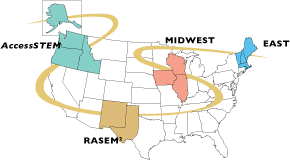
Respondent content will be updated over time and data can be analyzed at any point. Recognizing that at any point in time some respondents in the longitudinal tracking study will be still enrolled in secondary school or be recent high school graduates, besides graduation and career outcome data, the researchers are developing measures and analyses for respondents considered "on track" with respect to their progress through critical junctures that lead to degrees and careers in STEM. Preliminary analysis of data indicates that AccessSTEM staff is working with other Regional Alliances for Persons with Disabilities in STEM in order to collect common data from participants in each program. Ultimately, such data could be analyzed together and provide a model for NSF as it explores outcome data that should be collected for programs that serve to increase the participation of people with disabilities in STEM careers. They are also working to integrate new findings with those of earlier studies of promising interventions; studies related to DO-IT interventions are summarized in the next section.
Summary of Earlier Research Results Regarding DO-IT Interventions
The DO-IT Scholars program, originally funded in 1992 by the National Science Foundation and now funded by the State of Washington, supports transitions from high school to college to careers for students with disabilities. DO-IT Scholars are college-bound high school students who face significant challenges in pursuing postsecondary studies and careers as a result of their disabilities. They are not necessarily initially interested in STEM fields, but program activities include those designed to increase interest and knowledge in STEM. By providing on-campus summer study, year-round peer and mentor support, and work-based learning experiences, DO-IT helps these students develop self-determination, social, academic, technology, and career/employment skills and successfully transition to adult lives. Findings regarding DO-IT Scholar interventions are summarized below. A rich body of evaluation and research data has been collected on this program. It includes reports from Scholars, parents, and mentors and analyzes the value of program interventions, perceived outcomes, and participant differences with respect to gender, disability, and STEM interest. Some of the results are summarized in the following paragraphs.
Parents of DO-IT Scholars reported that DO-IT increased their children's interest in college; awareness of career options; self-esteem; and self-advocacy, social, academic, and career/employment skills (Burgstahler, 2002).
DO-IT Scholars reported that DO-IT participation helped them prepare for college and employment; develop Internet, self-advocacy, computer, social, and independent living skills; increase awareness of career options; and increase self-esteem and perseverance (Burgstahler, 2003; Kim-Rupnow & Burgstahler, 2004).
- They reported the greatest effects of the Summer Study to be the development of social skills, followed by academic and career skills; and the greatest effects of the year-round computer and Internet activities to be the development of career skills, also followed by academic and social skills (Burgstahler, 2003; Kim-Rupnow & Burgstahler).
- DO-IT Scholars considered themselves significantly improved in academic skills, social skills, levels of preparation for college and employment, levels of awareness of career options, and personal characteristics such as perseverance and self-esteem during the course of their participation in the DO-IT Scholars program, as demonstrated by their ratings at the following three time points—before their involvement in DO-IT, immediately following their first DO-IT Summer Study, and at the time they were surveyed (Kim-Rupnow & Burgstahler).
- Scholars reported positive aspects of email, which included being able to stay close to friends and family; to get answers to specific questions; to meet people from around the world; to communicate quickly, easily, and inexpensively with many people at one time; and to communicate independently without disclosing their disabilities (Burgstahler & Cronheim, 2001; Burgstahler & Doyle, 2005). They predicted that access to the Internet would contribute to their success in college and careers, and reported that peer and mentor relationships provided psychosocial, academic, and career support, and furthered their academic and career interests (Burgstahler, 2003; Burgstahler & Cronheim; Burgstahler & Doyle, 2005; Kim-Rupnow & Burgstahler). In particular, most reported that DO-IT mentors stimulated interests in STEM (Burgstahler & Cronheim; Burgstahler & Doyle).
- Those who participated in work-based learning opportunities reported increased motivation to work toward a career; knowledge about careers and the workplace; job-related skills; ability to work with supervisors and coworkers; and skills in self-advocating for accommodations (Burgstahler, 2001; Burgstahler, Bellman, & Lopez, 2004).
DO-IT Mentors—Mentors reported topics discussed with Scholars, to include STEM, college issues, disability-related issues, careers, and computers, assistive technology, and the Internet (Burgstahler & Cronheim, 2001).
Comparison of STEM and non-STEM-Oriented Participants
A recent study (Burgstahler & Chang, in press) compared the perceived benefits of program participation of participants with interests/strengths and/or career goals in science, technology, engineering, and mathematics (STEM group) and those without (non-STEM group) Highlights of the results are summarized below, organized by research question.
How does the STEM group compare with non-STEM group with respect to gender, disability type, major areas of postsecondary study, and primary motivations for going to college and gaining employment?
- Gender: Significantly more male respondents identified themselves as having STEM interests, strengths, and/or career goals than did female respondents.
- Disability type: Although respondents with mobility impairments were as likely as respondents with other types of disabilities to report interests/strengths in STEM fields, fewer reported a career goal in STEM fields.
- Postsecondary studies: Participants in the STEM group were more likely to study in STEM-related areas than those in the non-STEM group. Interestingly, there was a higher percentage (although not statistically significant) of students in the non-STEM group who majored in STEM fields (26%) as compared to the percentage of those in the STEM group who majored in non-STEM fields (13%).
- Primary motivation to attend college: Academic interest and love of learning/challenges was cited by more members of the STEM group, while job/career preparation was identified as a primary motivator for more of those in the non-STEM group.
- Primary motivation to seek employment: Financial security was selected by significantly more of the STEM group and pursuit of independent living was selected by significantly more of the non-STEM group. Potential mediators may be gender and disability type.
How does the STEM group compare with non-STEM group with respect to perceived changes in skills building during the course of DO-IT participations?
- Social skills: More non-STEM group participants reported improving their social skills than did their STEM group members. Specifically, no significant group difference was detected at Phases I and II except for at Phase III where the non-STEM group reported higher level of social skills than the STEM group.
- Self-advocacy skills: Non-STEM group participants consistently reported higher levels of self-advocacy skills than did STEM group members over the three phases, but both groups experienced significant improvements at a similar rate between phases.
How does the STEM group compare with non-STEM group with respect to perceived value and impact of DO-IT activities and participations
- Summer Study: Both groups placed the same high value on DO-IT activities.
- Year-round computer and Internet activities: Access to adaptive technology and access to information and resources on the Internet received significantly higher ratings from the STEM group.
- Greatest overall impact: The groups valued DO-IT in individual psychosocial development and readiness for college and career pursuits at the same levels.
Comparisons by Gender
A recent study (Burgstahler & Chang, 2007) compared the perceived benefits of program participation of girls and boys. Highlights of the results are summarized below, organized by research question.
How do the male compare with female participants with respect to STEM strength/career goals, disability type, major areas of postsecondary study, and primary motivations for going to college and gaining employment?
- STEM strength and future career goals: Significantly more males than females identified themselves as having STEM interests, strengths, and/or career goals.
- Disability type: No gender difference in disability type was found despite a slightly higher percentage of mobility impairments among the female participants.
- Primary motivations to attend college: Male and female participants did not differ in their reported motivations for going to college. The most common reason was career preparation, followed by academic interest/love of learning and commitment to family and friends.
- Primary motivations to seek employment: The most common reasons were independent living and financial security including incentive plans employment would offer, however, having financial security was significantly more important to male participants (60%) and achieving independent living was significantly more important to female participants (57%).
How do male compare with female participants with respect to perceived changes in themselves during the course of DO-IT participations?
- Perceived career options: Career options perceived by both genders increased significantly between phases, however female participant perceptions of career options changed more, suggesting greater changes in female participants during DO-IT participation.
How do the male compare with female participants with respect to perceived value and impact of DO-IT activities and participations?
- Summer Study: Both male and female participants highly valued DO-IT activities offered at Summer Study and no gender differences were detected.
- Year-round computer and Internet activities: Both groups highly valued computer and Internet activities, but no gender differences were detected.
- Greatest overall impact: Approximately similar percentages of male and female participants agreed that the greatest influence of DO-IT was in either individual psychosocial development or readiness for college and career pursuits.
In a follow-up (Burgstahler & Doyle, 2005) to the e-mentoring study (Burgstahler & Cronheim, 2001), researchers explored communication differences between males and females. True to gender stereotypes, males were more preoccupied with the Internet and other technology and females with personal issues. This result suggests that technology is still a male bastion and that finding ways to encourage females to develop skills and positive self-concepts in the area of information technology (IT) is of critical importance if we are to increase their participation in IT fields.
STEM Majors and Degrees at UW
It is impossible to determine the effect of DO-IT activities on the number of students with disabilities majoring in and graduating in STEM fields at the University of Washington (UW) and other institutions. Specifically, there is no comparison group; UW data collected is only about a small subset of students with disabilities, namely those who request accommodations through Disability Resources for Students, which is estimated to be no more than 1/3 of the total number of students with disabilities at the UW; and a cause-effect relationship cannot be established simply from correlations. Given these limitations, it is still of some interest to compare available data about STEM degrees and majors of UW students with documented disabilities and students who have not disclosed disabilities.
It is important to keep in mind that MOST interventions undertaken by DO-IT since 1992 do not focus on the UW; instead, they outreach to students and institutions state-wide, regionally, nationally, and internationally. Some interventions encourage the participation of students with disabilities in STEM degrees (e.g., those funded by the National Science Foundation such as AccessSTEM, but others are more generally focused on increasing the success of students with disabilities in college and careers; further, some STEM-related interventions reach out to students already interested in STEM fields, but most do not. It should also be noted that DO-IT interventions promote self-determination skills for students with disabilities and the application of universal design for instruction and student services; together, these efforts can lead to fewer students reporting disabilities to DRS, as students make use of technology (e.g., Braille translation and speech output systems for students who are blind) and other interventions to gain access to curriculum and as faculty and staff make their resources (e.g., websites) more accessible to students who have disabilities. The table below should be interpreted with these limitations in mind. It reports STEM degree and major information for UW students who disclose and for students who do not disclose disabilities.
| Year | With Disclosed Disabilities | Without Disclosed Disabilities | ||||||
|---|---|---|---|---|---|---|---|---|
| STEM Degrees | STEM Majors | STEM Degrees | STEM Majors | |||||
| Bachelors | Graduate | Bachelors | Graduate | Bachelors | Graduate | Bachelors | Graduate | |
| 1991 | 22 | 2 | 105 | 14 | 2,736 | 916 | 9,129 | 3,774 |
| 2002 | 52 | 5 | 129 | 26 | 3,648 | 1,190 | 11,320 | 4,361 |
| 2007 | 59 | 11 | 245 | 49 | 3,908 | 1,258 | 13,13 | 4,667 |
1991 (Pre-DO-IT) to 2007
- Degrees: There was a 168% increase in undergraduate and 45% increase in graduate degrees in STEM earned by students who reported disabilities; there was only a 43% increase in undergraduate and 37% increase in graduate degrees in STEM for others.
- Majors: STEM majors increased 133% for undergraduate and 250% for graduate students with disabilities, but only 44% and 24%, respectively, for others.
2002 (Pre-AccessSTEM) to 2007
- Degrees: There was a 14% increase in undergraduate and 120% increase in graduate degrees in STEM for students with disabilities; there was only a 7% increase in undergraduate and 6% increase in graduate degrees in STEM for others.
- Majors: STEM majors increased 89% for undergraduate and 82% for graduate students with disabilities, but only 16% and 7%, respectively, for others.
References
Berkner, L., Wei, C.C., He, S., Cominole, M., & Siegel, P. (2005). 2003-04 National postsecondary student aid study (NPSAS:04): Undergraduate financial aid estimates for 2003-04 by type of institution (NCES2005-163). U.S. Department of Education. Washington, DC: National Center for Educational Statistics. Retrieved November 30, 2007 from http://nces.ed.gov/pubs2005/2005163.pdf.
Burgstahler, S. (2001). A collaborative model promotes career success for students with disabilities: How DO-IT does it. Journal of Vocational Rehabilitation, 16(129), 1-7.
Burgstahler, S. (2002). The value of DO-IT to kids who did it! Exceptional Parent, 32(11), 79-86.
Burgstahler, S. (2003). DO-IT: Helping students with disabilities transition to college and careers. National Center on Secondary Education and Transition Research to Practice Brief, 2(3).
Burgstahler, S., Bellman, S., & Lopez, S. (2004). Research to practice: DO-IT prepares students with disabilities for employment. NACE Journal, 65(1).
Burgstahler, S., & Chang, C. (2007, in press). Promising interventions for promoting STEM fields to students who have disabilities. Review of Disability Studies.
Burgstahler, S., & Chang, C. (2007). Gender differences in perceived value of components of a program to promote academic and career success for students with disabilities.
Burgstahler, S., & Cronheim, D. (2001). Supporting peer-peer and mentor-protégé relationships on the Internet. Journal of Research on Technology in Education, 34(1), 59-74.
Burgstahler, S., & Doyle, A. (2005). Gender differences in computer-mediated communication among adolescents with disabilities: Science, technology, engineering, and mathematics case study. Disability Studies Quarterly, 25(2). Retrieved February 20, 2007, from http://dsq-sds.org/article/view/552/729
Committee on Equal Opportunities in Science and Engineering (CEOSE). (2004). Broadening participation in America's science and engineering workforce. The 1994-2003 Decennial and 2004 Biennial Reports to Congress.
Grubb, W.N. (1999). Learning and earning in the middle: The economic benefits of sub-baccalaureate education. Community College Research Center, New York.
Kim-Rupnow, W. S., & Burgstahler, S. (2004). Perceptions of students with disabilities regarding the value of technology-based support activities on postsecondary education and employment. Journal of Special Education Technology, 19(2), 43-56. Retrieved February 20, 2007, from https://www.learntechlib.org/p/99229/
National Center for Education Statistics (NCES) (2007a). The condition of education 2003. Washington, DC: U.S. Department of Education (NCES 200-067). Retrieved November 20, 2007, from http://nces.ed.gov/Pubsearch/pubsinfo.asp?pubid=2007064
National Center for Education Statistics (NCES) (2007b). Dropout rates in the United States: 2005. U.S. Department of Education, Office of Educational Research and Improvement (NCES 2007-059). Retrieved November 20, 2007, from http://nces.ed.gov/pubs2007/2007059.pdf
National Organization on Disability (NOD). (2004). The 2004 National Organization on Disability/Harris Survey of Americans with disabilities. Washington, D.C.: Author. Retrieved January 20, 2007, from http://nod.org/assets/downloads/NOD-Harris-Summary-2004.pdf
SRI, International (1987-1993). National longitudinal transition study (NLTS) Menlo Park, CA: Author. Retrieved February 11, 2007, from https://nlts2.sri.com/reports/nlts_report/TransitionExperiences_December1993.pdf
Wagner, M., Newman, L., Cameto, R., & Levine, P. (2005a). Changes over time in the early post-school outcomes of youth with disabilities. A report of findings from the National Longitudinal Transition Study (NLTS) and the National Longitudinal Transition Study-2 (NLTS2). Menlo Park, CA: SRI International
Wagner, M., Newman, L., Cameto, R., & Levine, P. (2005b). After high school: A first look at the post-school experiences of youth with disabilities. A report of findings from the National Longitudinal Transition Study-2 (NLTS2). Menlo Park, CA: SRI International
Acknowledgments
This summary was prepared by S. Burgstahler and C. Chuan for the 2007 PacRim Conference on Disabilities. Contents are taken from referenced articles. The DO-IT Scholars program has been funded by the National Science Foundation (grant numbers 9255803, 9550003, and 9800324) and the State of Washington. Preparation of this summary was partially supported by grants from the U.S. Department of Education, the National Institute on Disability Rehabilitation Research, and the Office of Special Education Programs (grant #H133B980043), as well as the Rehabilitation Services Administration (grant #H235N010014) and the National Science Foundation (cooperative agreement #HRD-0227995).
Note: The opinions expressed in this document are those of the authors and do not necessarily reflect those of the funding agencies.