Progress of DO-IT Participants Toward College and Careers

People with disabilities are underrepresented in challenging academic and career fields, including those in science, technology, engineering, and mathematics (STEM). Since 1992, DO-IT (Disabilities, Opportunities, Internetworking, and Technology) has undertaken activities to increase the success of people with disabilities in college and careers.
DO-IT has encouraged participation in STEM fields with funding from the National Science Foundation (NSF). DO-IT's latest NSF-funded projects are AccessSTEM and AccessComputing. The goal of AccessSTEM is to increase the number of individuals with disabilities who have degrees and careers in STEM. AccessComputing focuses more specifically on computing fields and employment.
The ALTS
The AccessSTEM/AccessComputing/DO-IT Longitudinal Transition Study (ALTS) explores college and career outcomes for students with disabilities who have participated in DO-IT activities that were at least partially funded by NSF. Current results can be found at https://www.washington.edu/doit/2011-report-accessstemaccesscomputingdo-it-longitudinal-transition-study-alts. This report summarizes DO-IT interventions and selected results of the ALTS.
The ALTS measures progress toward degrees and careers of students with disabilities who had a goal of postsecondary education while in high school and received DO-IT-sponsored interventions (e.g., internships, mentoring, college transition activities).
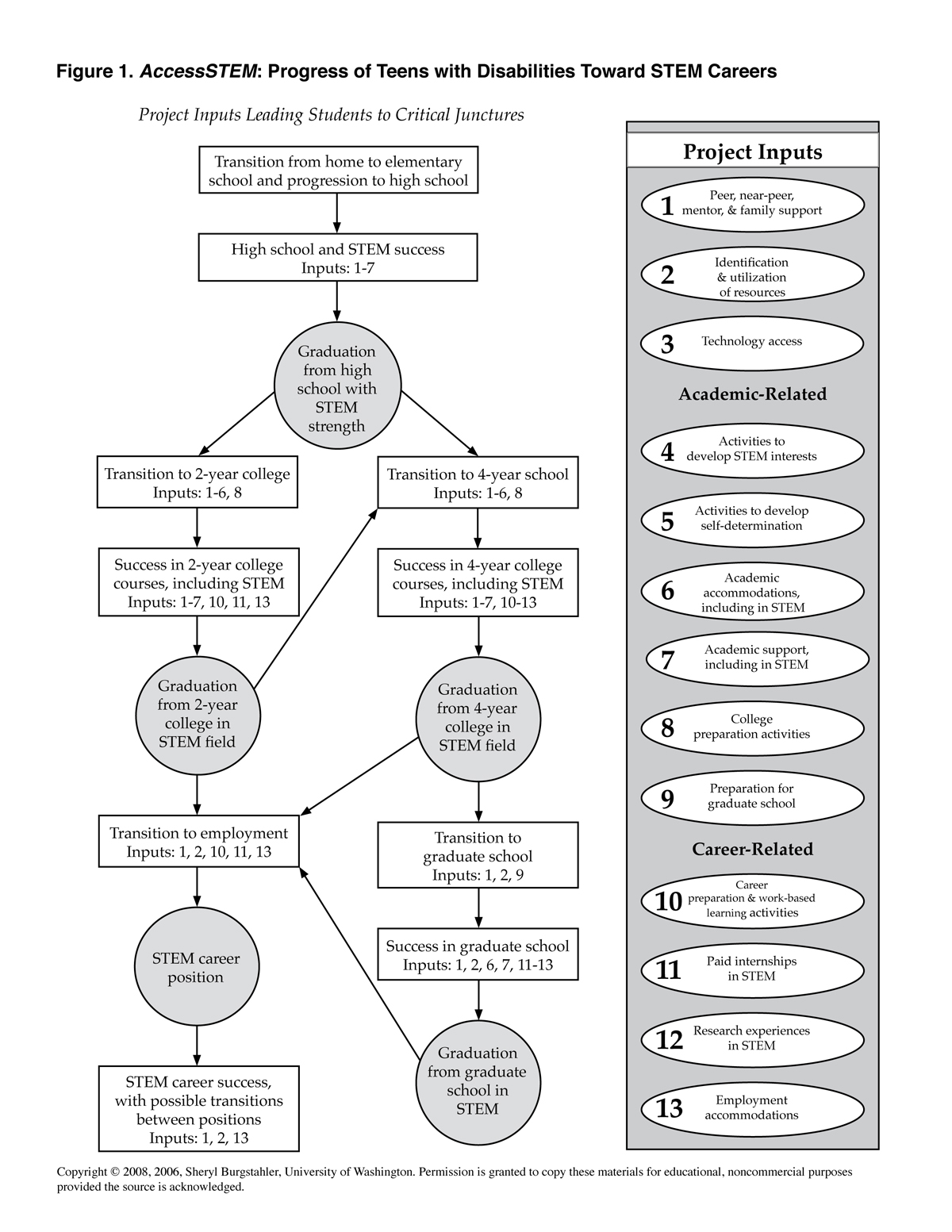
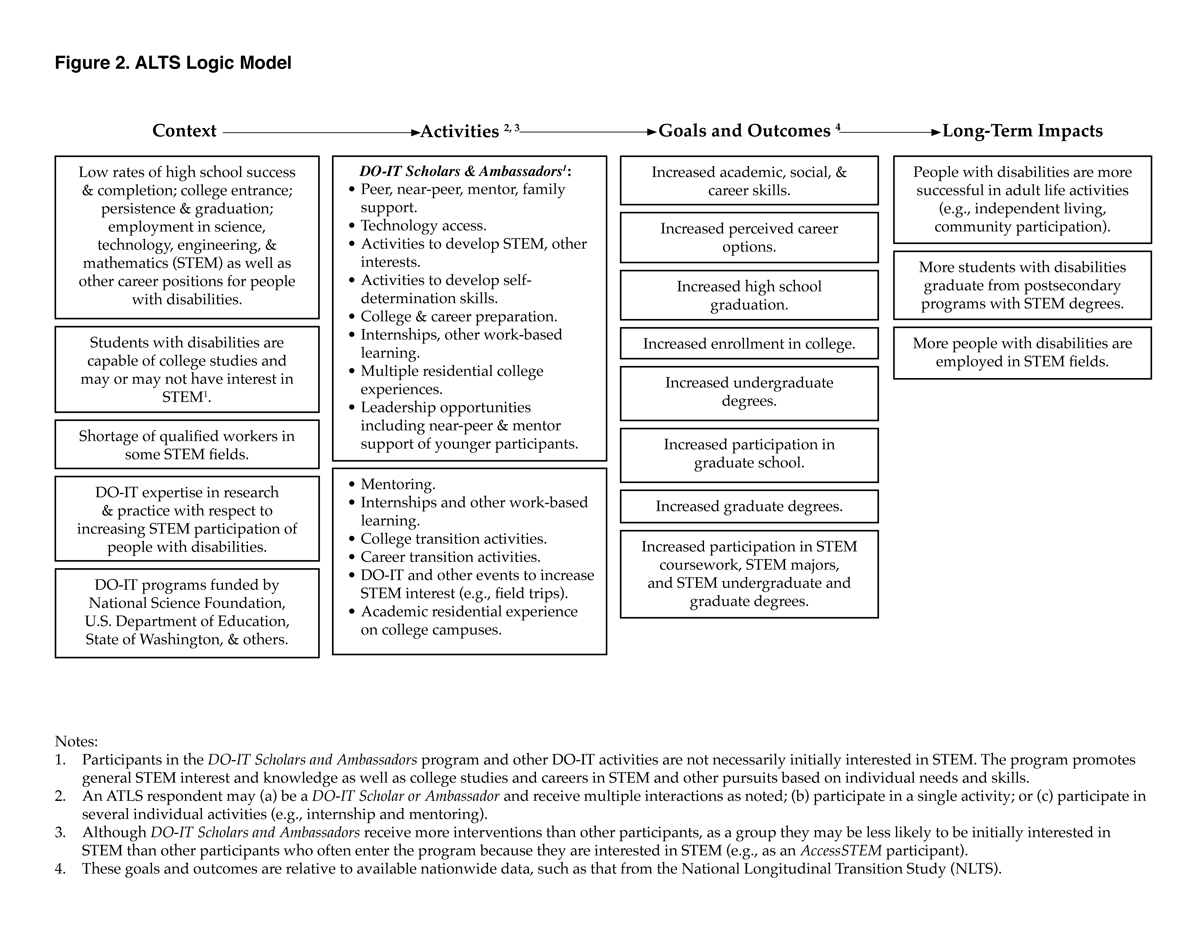
The ongoing study is designed so that participant responses can be updated and data can be analyzed at any time. Recognizing that some respondents in the study are still enrolled in secondary school or are recent high school graduates, the researchers track the status of respondents as they progress through critical junctures that lead to degrees and careers (Figure 1). The ALTS Logic Model (Figure 2) provides a visual representation of DO-IT activities in which respondents were involved, as well as project outputs, goals, outcomes, and long-term impacts.
The data of ALTS respondents are compared to statistics from nationwide studies, including the National Longitudinal Transition Study (NLTS and NLTS-2) (SRI International, 2001-2011) which is a follow-up of the original National Longitudinal Transition Study (SRI International, 1985-1993).
Results
As of February 2011, ALTS included a total of 294 respondents with disabilities that affect:
- mobility 44%
- learning 22%
- psycho-social issues 20%
- hearing 18%
- vision 13%
- chronic health 6%
- communication 5%
- other 12%
Participation
Respondents participated in the following evidence-based practices:
- Technology access. The proportion of respondents who had access to assistive software or hardware was quite low (27%) before participation in DO-IT programs, but very high (64%) after participation.
- Internships and other work-based learning. Sixty-eight percent (68%) of respondents completed at least one internship. Fifty-four percent (54%) of the participants with internships (37% of the participants overall) had paid internships.
- Mentoring. Ninety-six percent (96%) of respondents reported having access to mentors during program participation, up from 36% before participation.
- College and career transition workshops and camps. Eighty-one percent (81%) of the respondents indicated that they participated in a college or career transition workshops.
- Other STEM activities. One third of respondents (30%) were involved in other extracurricular STEM service groups, clubs, or other activities.
Participants and staff rated the value of all interventions highly for promoting college and career success.
Education
ALTS participants experienced a 100% high school completion rate; in comparison, the high school completion rate of NLTS and NLTS2 participants was 54% and 70%, respectively. Approximately half of both ALTS and NLTS postsecondary participants began their postsecondary studies at technical or two-year colleges.
An overwhelming majority (95%) of ALTS high school graduates attended a two- or four-year college, of which 95% attended within two years from high school graduation. This outcome suggests the positive impact of DO-IT interventions when compared to the NLTS participants of which 31% took a postsecondary course within two years after high school. This finding is not surprising to DO-IT staff who consider the ongoing program supports, as noted in DO-IT's critical junctures model (Figure 1), essential for many students with disabilities to transition successfully to and succeed in college and careers.
At the time the data was collected, 27%, 56%, and 50% of ALTS respondents at two-year, four-year, and graduate schools, respectively, majored in STEM. Ninety-five respondents earned a total of one hundred and twenty-two postsecondary degrees, fifty-five (45%) of these certificates or degrees were in STEM. In contrast, a national postsecondary student aid study by the National Center for Education Statistics (NCES) (Berkner etal., 2005), found that even though undergraduate students with disabilities choose natural sciences and engineering at the same rate (18%) as students without disabilities, graduate students with disabilities are less likely than those without disabilities to major in natural sciences and engineering. Specifically, 9% percent of the NCES graduate students with disabilities majored in natural sciences and engineering as compared to 13% of graduate students without disabilities. These results suggest that DO-IT interventions may be helping to fill the gap in STEM studies between youth with and without disabilities.
Perhaps DO-IT's greatest impact on the number of STEM degrees earned by students with disabilities results from interventions that increase degree attainment overall. The total number of STEM degrees is likely larger than what it would be otherwise due to the increased pool of college graduates with disabilities as a result of these interventions. Data should be analyzed in light of the fact that DO-IT recruits students with disabilities who are not necessarily initially interested in STEM, as noted in the "Earlier Research Results Regarding DO-IT Interventions" section of this publication. Data suggest that DO-IT interventions increase the overall perception of career options of participants, particularly girls, and the interest in STEM of those not initially interested in STEM.
Post-School Employment
Seventy-three ALTS respondents were recorded as currently "employed" in positions. Forty (40%) percent of these positions were STEM-oriented or in fields with significant technology demands. Among those not still enrolled in college, seventy (70%) percent of those who partipated in extracurricular STEM organizations and activities were employed, asignificantly higher percentage than the percentage of those who did not (44%). Among those still enrolled in college, 21% of those in extracurricular STEM activities are employed, as are 15% of those who are not involved in similar activities.
Many participants who pursued non-STEM careers (e.g., accounting, law, education, journalism) benefited from the STEM knowledge and encouragement they gained through DO-IT activities. Their positive responses to ALTS questions about the value of DO-IT interventions suggest that these activities supported the NSF goal of expanding the STEM literacy of all citizens. For example, participants who were encouraged to take mathematics courses as a result of DO-IT activities are prepared to pursue math-intensive careers such as accounting. Participants who became teachers are now in positions to encourage other young people with disabilities to consider STEM careers. Those who have become attorneys and other professionals serve as role models to young people with disabilities, helping them consider career options that they previously thought were unattainable.
Earlier Research Results Regarding DO-IT Interventions
The DO-IT Scholars program, originally funded in 1992 by NSF and now funded by the State of Washington, supports transitions from high school to college and careers for students with disabilities. DO-IT Scholars are college-bound high school students who face significant challenges in pursuing postsecondary studies and careers as a result of their disabilities. They are not necessarily initially interested in STEM fields, but program activities include those designed to increase interest and knowledge in STEM. By providing an on-campus summer study, year-round peer and mentor support, and work-based learning experiences, DO-IT helps these students develop self-determination, social, academic, technology, career, and employment skills and successfully transition to adulthood.
A rich body of evaluation and research data has been collected on this program. It includes reports from Scholars, parents, and mentors and analyzes the perceived value of program interventions and participant differences with respect to gender, disability, and STEM interest. Some of the results are summarized at https://www.washington.edu/doit/2011-report-accessstemaccesscomputingdo-it-longitudinal-transition-study-alts. Highlights include the following:
- Parents of DO-IT Scholars reported that DO-IT increased their children's interest in college; awareness of career options; self-esteem; and self-advocacy, social, academic, career, and employment skills.
- DO-IT Scholars reported that DO-IT participation helped them prepare for college and employment; develop Internet, computer, self-advocacy, social, and independent living skills; increase awareness of career options; and increase self-esteem and perseverance.
- Those who participated in work-based learning opportunities reported increased motivation to work toward a career, gain knowledge about careers and the workplace, learn job-related skills, improve their ability to work with supervisors and coworkers, and increase skills in self-advocating for accommodations.
- Fewer participants with mobility impairments reported a career goal in STEM fields than those with other types of disabilities.
- There was a higher percentage of students who began with low interest or aptitude in STEM and majored in STEM fields as compared to those who began with interest or aptitude in STEM and majored in non-STEM fields in college.
- Significantly more males than females identified themselves as having STEM interests, strengths, and career goals.
- Career options perceived by both genders increased significantly during DO-IT participation; however, female participant perceptions changed more.
Conclusion
The ALTS and earlier studies suggest that DO-IT interventions positively impact high school and college graduation rates and career participation, particularly in STEM fields, for people with disabilities.
References
Berkner, L., Wei, C. C., He, S., Cominole, M., & Siegel, P. (2005). 2003-04 National postsecondary student aid study (NPSAS:04): Undergraduate financial aid estimates for 2003-04 by type of institution (NCES2005-163). U.S. Department of Education. Washington, DC: National Center for Educational Statistics. nces.ed.gov/pubs2005/2005163.pdf
Burgstahler, S., Moore, E., & Crawford, L. (2007). Report of the AccessSTEM/AccessComputing DO-IT longitudinal transition study (ALTS). Seattle: University of Washington. https://www.washington.edu/doit/2011-report-accessstemaccesscomputingdo-it-longitudinal-transition-study-alts
SRI International (1987-1993). National longitudinal transition study (NLTS) Menlo Park, CA: Author.
Wagner, M., Newman, L., Cameto, R., Garza, N., & Levine, P. (2005). After high school: A first look at the postschool experiences of youth with disabilities. A report of the National Longitudinal Transition Study-2 (NLTS-2). Menlo Park, CA: SRI International.
Acknowledgments
The content of this publication was taken with permission from Report of the AccessSTEM/AccessComputing> DO-IT Longitudinal Transition Study (ALTS) at https://www.washington.edu/doit/programs/accessstem/resources/accessstemdo-it-longitudinal-transition-study-alts/2010-report. The DO-IT Scholars program, in which many study respondents participated, has been primarily funded by the National Science Foundation (grant #9255803, 9550003, and 9800324) and the State of Washington since 1992.
The AccessSTEM/DO-IT Longitudinal Transition Study (ALTS) is supported by the National Science Foundation (award #HRD-0227995, HRD-0833504 in RDE, and CNS-0540615 and CNS-0837508 in CISE). Any opinions, findings, and conclusions or recommendations expressed in this material are those of the authors and do not necessarily reflect the views of the National Science Foundation.
About DO-IT
DO-IT (Disabilities, Opportunities, Internetworking, and Technology) serves to increase the successful participation of individuals with disabilities in challenging academic programs such as those in science, engineering, mathematics, and technology. Primary funding for DO-IT is provided by the National Science Foundation, the State of Washington, and the U.S. Department of Education. DO-IT is a collaboration of UW Information Technology and the Colleges of Engineering and Education at the University of Washington.
Grants and gifts fund DO-IT publications, videos, and programs to support the academic and career success of people with disabilities. Contribute today by sending a check to DO-IT, Box 354842, University of Washington, Seattle, WA 98195-4842.
Your gift is tax deductible as specified in IRS regulations. Pursuant to RCW 19.09, the University of Washington is registered as a charitable organization with the Secretary of State, state of Washington. For more information call the Office of the Secretary of State, 1-800-322-4483.
To order free publications or newsletters use the DO-IT Publications Order Form; to order videos and training materials use the Videos, Books and Comprehensive Training Materials Order Form.
For further information, to be placed on the DO-IT mailing list, request materials in an alternate format, or to make comments or suggestions about DO-IT publications or web pages contact:
DO-IT
University of Washington
Box 354842
Seattle, WA 98195-4842
doit@uw.edu
www.uw.edu/doit
206-685-DOIT (3648) (voice/TTY)
888-972-DOIT (3648) (voice/TTY)
206-221-4171 (fax)
509-328-9331 (voice/TTY) Spokane
Founder and Director: Sheryl Burgstahler, Ph.D.
Copyright © 2012, 2010, 2009, 2008, University of Washington. Permission is granted to copy these materials for educational, noncommercial purposes provided the source is acknowledged.