You will want to have your Notice of Award (NoA) readily available when you are completing this section. The dates and amounts entered here must match those on the NoA, or you will risk the request being returned by OSP.
Short Title (required): This field is auto-populated from the application eGC1, it is an editable field.
Full Title (required): This field is auto-populated from the application eGC1, it is an editable field.
Period 1 Start Date (required): Must match the Notice of Award.
Authorized Period End Date (required): Must match the Notice of Award.
Sponsor Total for Spending Period: This must match the total amount listed on the Notice of Award and on the accompanying SAGE Award Budget.
Estimated Award End Date: found on the Notice of Award.
Sponsored Program Activity Type (SPA) (required): This field is auto-populated from the application eGC1, it is an editable field.
Select the appropriate SPA type from the drop-down menu. Available selections align with GIM 13 Activity Types. Note that the SPA selection is based on the originating sponsor type for federal vs. non-federal distinctions.
Clinical Trial Phase (drop-down menu): This field is auto-populated from the application eGC1, it is an editable field.
Values: I, II, III, IV, Other, None: Found on the Notice of Award. Review defining clinical research for more information on clinical trial phases.
Project Type (required): This field is auto-populated from the application eGC1, it is an editable field.
Sponsor Award Issue Date: Found on the Notice of Award.
Sponsor Award Number: Found on the Notice of Award.
Non-Monetary Award (toggle)
Select the toggle when the sponsor has issued a non-monetary award or an award with a non-monetary component, such as a dollar-valued in-kind contribution or an equipment non-monetary award.
When toggle is selected the Non-Monetary Award Amount field will display. Complete this field with the value of the in-kind or equipment contribution.
Sponsor Details
Sponsor (required): This field is auto-populated from application eGC1, it is an editable field. Check your Notice of Award to determine if the Sponsor for the award is different than the one at the time of proposal. Sponsor accuracy is very important to Workday setup.
If you are attempting to change the sponsor on the ASR and do not get results from your search, that indicates that the sponsor may need to be setup in UW’s funding entity core data management (FECDM) system. Click the link on screen to Request Sponsor Setup in FECDM (Funding Entity Core Data Management).”
Sponsor Type: this is not an editable field.
Bill to Sponsor: This is an editable field.
Funding originates from a different entity than the sponsor listed above (flow-through). Select the toggle to display the following fields:
Originating (Prime) Sponsor (required): Auto-populated from eGC1.
Originating (Prime) Sponsor Type: This is not an editable field.
Originating (Prime) Sponsor Award Number: This is not a required field, it is an editable field.
The sponsor has a deadline for accepting the award.
Use this only when the sponsor has specified a deadline for receiving the signed award to provide funding. Upload the required documentation of the deadline from the sponsor in the Supporting Attachments section.
Select the toggle to display the following fields:
Deadline for Accepting Award Date (required)
Instructions for where data source can be found in the Notice of Award.
PI & Department
Cost Center (required): This field is auto-populated from the application eGC1, it is an editable field.
OSP and GCA can apply and remove holds from an Award Setup Request or a Modification Request.
A hold can be placed for a variety of reasons and applied when the Award Setup Request or the Modification Request is in any of the following statuses:
OSP Setup
OSP Assigned
Returned
GCA Assigned
GCA Workday setup
Types of Holds
The following manual holds and compliance checks may be applied to your Award Setup Request or Modification Request:
General Hold
Export Control Hold
IACUC Approval Hold
IRB Approval Hold
Campus Input Required
Sponsor Input Required
GCA/OSP Coordination Required
Knowing a Hold has been Placed
On the Award Request List
If a hold is applied to the Award Setup Request or Modification Request, a hold indicator icon will display to the right of the Request ID.
The following image shows an example of an added hold on the Award Request List:
In the Request
Once a Hold is applied to the Award Setup Request or Modification Request, near the top of the page, the following text will display in a blue font color (on all pages):
“Holds or compliance checks are in process. View the Comments & History section for more information.”
Note: There is no campus email notification when a hold is placed or removed on an ASR or MOD.
The following image shows an example of this text:
In Comments & History
More detailed information is displayed in the Comments & History section of the Award Setup Request or a Modification Request.
The following image shows an example of an added hold:
Use this section of your award to review the Significant Financial Interest (SFI) and Financial Conflict of Interest (FCOI) Training status of the investigators on the associated eGC1 application. The table lists each investigator, their role, SFI disclosure submission status, and FCOI training status. If any investigators are not up-to-date, an alert appears above the table. The green check marks will indicate at a glance if training and disclosures are up-to-date.
SFI Disclosure Requirement
An investigator’s disclosure status is either “Up-to-date” or “Disclosure Required”. Each investigator must have completed an SFI disclosure in FIDS for the associated eGC1 application whether or not they have any financial interests to disclose. If the investigator submitted that disclosure more than 12 months ago from the current date, and has not created another disclosure of any kind within the past 12 months, the investigator would need to submit an annual update disclosure.
To view and confirm the SFI review status, review the investigator’s disclosure history on the eGC1 PI, Personnel, & Organizations page. From the ASR, select the eGC1 link in the upper right of the header, then click the PI, Personnel & Organizations section and locate the Investigator Disclosure History link within the Compliance Details section.
FCOI Training Requirement
If the eGC1 application’s sponsor, regulations, or other terms and conditions require FCOI Training, the investigator’s FCOI training must also be “up-to-date.” The training expires after four years. If the investigator’s training is not current, their status is “Training Required”. The investigator must be notified about the training requirement via email from OR. Please review GIM 10 for additional information.
Note: Updates to NIH’s Other Support requirement NOT-OD-25-133 may require investigators to complete the FCOI & Other Support training prior to the listed expiration date. For additional information review Current and Pending, or Other Support guidance.
Below the table is a link to the parent eGC1 application’s PI, Personnel, & Organizations page where you can update the list of investigators. If you make changes, the award will automatically update.
The following image shows an example of an investigator who is not up-to-date for neither SFI disclosure nor FCOI training.
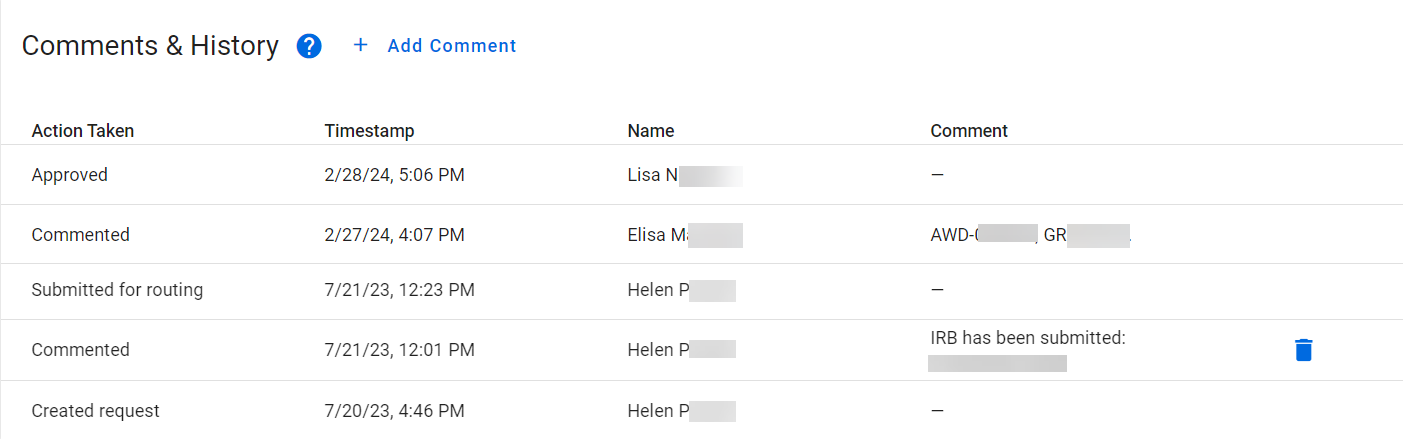
The Comments & History section displays entries for events in the award request process. You can also add a comment at any time. The entries display in reverse chronological order, so the most recent one is first.
The following image shows an example of this page for a fully processed award.
Note: Not all actions have comments, such as system-generated history events. For those entries, a dash (-) will appear in the Comment column.
Add and Delete Comments
You can manually add a comment by selecting the Add Comment button above the table, as shown in the following image.
A dialog window will display. When you start entering your comment, the Add Comment button in the lower right corner of the window will be enabled. Ensure you add explanatory comments to your requests for anything that might not be clear to OSP or GCA. Select Add Comment to save your comment.
You can only delete your own manually added comments. To remove the comment, select the trash can icon to the right of the comment in the table.
You can also add a comment from anywhere within the Award Setup Request by selecting the “more actions” (3 vertical dots) icon at the far left of the header, and choosing Add Comment.
ASR & MOD Comment Examples
Information Type
Sample Information to provide within comments
ASR
MOD
Explain what you are asking for on the Modification request
No Cost or Temporary Internal Extension?
Please extend Workday Grant IDs GR123456, GR123457
Change of PI?
We need to change Dr. XYZ to Dr. ABC
Progress report/RPPR?
Indicate the request is for a progress report
X
Compliance Details
IRB study numbers and approval dates or if items are pending, indicate they are pending:
UW IRB STUDY00123456 approved thru 1/26/25
OAW approval uploaded to Supporting Attachments
Dr. Harriette Husky is in the process of completing her FCOI training
X
X
Sponsor Contact information
Please send all correspondence to sponsor contact: Dr. Jane Doe, jane.doe246@acme.com
X
X
Sponsor Deadline for Accepting Award or Modification?
Include details about the deadline
X
X
Awards with Advances
ADV12345 approved for this award
X
NIH fellowship awards
I am working with the fellow and mentor to get original signatures on the Activation Notice. Once I have these, I will send the original to OSP for institutional signature and to send to NIH.
X
Comments & History Event Entries
The system will add an entry for the events described in the following table. The “Comment Type” column indicates if there will be any comment text, and if so, whether it is system-generated or user-entered.
History Event
Event Trigger
Comment Type
Created request
Clicking “Select” button next to eGC1
(none)
Submitted for routing
Clicking “Submit & Route” button on Review & Submit page
System-generated
Resubmitted for routing
Clicking “Submit & Re-Route” button on Review & Submit page after a return
User-entered and required
Approved
Clicking “Approve” button on Request Summary page of routing Award Setup Request or Modification Request
(none)
Returned
Clicking “Return Request” button in return modal of Award Setup or Modification Request
User-entered and required
Withdrawn
Clicking “Withdraw” button
(none)
Added ad hoc approver
Clicking “Add ad hoc Approver” button in add approver modal
User-entered and optional
Removed ad hoc approver
Clicking “Remove Approver” button on the ad hoc approver’s workflow graph node
User-entered and optional
Commented
Clicking “Add Comment” button on the Comments & History page, or by selecting “Add Comment” from the “more actions” menu in the advance header
When you receive a Notice of Award (NoA) for a new award or a competing renewal, you will need to create an Award Setup Request (ASR) in SAGE to initiate the actions needed to setup your award in Workday Finance. If you are uncertain whether to create an Award Setup Request or a Modification Request, refer to the How do I know if I should create an Award Setup Request or a Modification Request? FAQ.
Before Getting Started
In order to create an Award Setup Request, you will need to be listed on the Contacts and Access page of the proposal eGC1. If you are not already listed, you will need to ask one of the owners to add you to the eGC1 as an owner or with read/write access. You can view the owners on the eGC1 by going to the eGC1 Forms section in SAGE, clicking on Advanced Search, entering the eGC1 and clicking Search. In the results row, click on the Contacts link at the far right, to view the Owners that can grant you access to the eGC1.
Note: Read-Only access will not provide access to edit or create award items.
As an alternative, an existing eGC1 contact can create the ASR, and add you as an award preparer to the ASR, for you to continue the process.
Create a Request
To create an ASR, start at the Awards tab and select the Create A Request button at the upper right.
Note: You can also start a new request from the Award Requests tasklist.
The following image shows the Awards tab in SAGE.
When you select the Create A Request button, a menu displays with the option to create an Award Setup Request.
The following image shows this menu:
Select Award Setup Request from the menu. Use the search to find the associated eGC1 application. You can search by eGC1 number, PI (Principal Investigator), or Short Title (short name), then select the desired eGC1.
Only eGC1s in Approved status and not already linked to an Award Setup Request will display. eGC1s for Non-Award Agreement or Pre-Applications will not display.
An Award Setup Request form will open, displaying the General Information page by default. SAGE auto-fills details from your eGC1 (Short Title, Full Title, Sponsor, Bill to Sponsor, and PI).
Navigating the ASR
The left navigation menu displays all of the required sections of the ASR at top, and the additional Approval flow, Access & Roles, and Comments & History sections at the bottom. You can use the left navigation to switch between forms, or within each form you will see a Next Section button in the lower right navigation as an alternative.
The following image shows the navigation menu, with the General Information section highlighted. If all of the required information is entered for a given section, you will see a grey checkmark next to the section name.
ASR Information Entry
The auto-filled information on the Award Setup Request can be updated, with the exception of the PI, since information may change between time of proposal and time of award. You can also update the award’s start and end dates, funding amounts, and other details, as needed. See detail on each individual section’s entry requirements in the section-by-section help documentation listed below:
A SAGE Budget is required for all Award Setup Requests (ASR), and is connected to the ASR on the Budget and Award Lines page. You can learn more about creating a SAGE award budget on the SAGE Budget Resources page. Note that Clinical Trial budgets reviewed by the UW CTO do not need to contain any amounts, only the necessary data needed for Workday award setup, as outlined in the Creating a Clinical Trials Budget for SAGE Awards job aid.
Connect Budget Breakdown from SAGE Budget
Your SAGE award budget identifies how you would like your awarded funds to be set up in Workday. A SAGE Budget is required as indicated by the red asterisk.
Create your SAGE Budget
Create a new award budget in SAGE Budget or copy and modify an existing SAGE Budget. The level of detail required for the award budget should be tailored to the sponsor’s requirements and campus unit needs. Award budgets are often less detailed than proposal budgets. It is usually simpler to create a new award budget from scratch.
Ensure the Sponsor Total on the General Information page matches the Budget Total on the Budget and Award Lines page of the ASR; otherwise, you will be unable to route your award.
Note: Since the “Primary Worksheet’s” name integrates into Workday as the Grant Name, it is best to title the “Primary Worksheet” as you want it represented in Workday.
Connect your SAGE Budget
Once you have created your SAGE award budget—with amounts and periods that match your notice of award—connect your budget to the Award Setup Request. In the Search for a budget box you can type a budget title, budget number or PI last name to display all eligible budgets matching your criteria.
Note: Eligible budgets include SAGE Budgets that are not currently connected to an eGC1 or another ASR.
The following image shows the search box:
Next, select your budget from the results list:
After your budget is connected, the following information will display:
Budget name and BudgetID.
Open Budget button.
This opens the connected SAGE Budget in a new browser tab.
A list of the Period(s) connected with start date and end date.
SAGE will automatically select Period 1.
Select any additional periods authorized by your sponsor.
Note: Any changes made to your SAGE Budget will sync to the Award Setup Request form, until the Award Setup Request is submitted. Changes can also be made to the budget when the ASR is in Returned status.
SNAP Award Period Setup: To streamline the SNAP award process and eliminate the need for temporary budget extensions, SNAP awards will be set up for the full anticipated duration of the award. Therefore, select all budget periods at time of ASR. However, also note that only period 1 should contain amounts. Future periods should contain $0, until the supplemental modification comes through for the next period. Review NIH SNAP: A Detailed Guide for Completing the Award Setup Request in SAGE for more details.
Note: You will be required to ensure the connected budget start and end dates align with the General Information page before submitting. When the dates do not match, you will see the following validation message at the top of the Budget & Award Lines section.
Change the Connected Budget
You can change the connected SAGE Budget if the status is:
Composing
Returned, but only if OSP has not approved
Withdrawn (available only when routing to an ad hoc approver)
A Change Budget link will display to the right of the Open Budget link, as shown in the following image:
Selecting this link will open the Change Budget? dialog window. You can search for the desired budget by budget title, BudgetID number, or PI.
The following image shows the dialog window:
Select your budget from the results list and select the Change Budget button. The page will update to reflect the updated information.
View the Award Budget By Period
The Award Budget By Period portion of the Budget & Award Lines form section includes a tab for each period selected, with its description, and an “All Periods” tab on the left if more than one period was selected.
To the right of the section are three buttons:
Expand Budget: opens the Award Line Details sections for the entire budget.
Collapse Budget: closes the Award Line Details sections for the entire budget.
Customize Details View: allows you to customize your view of budget data by toggling Object Class Details and Award Line Details on or off. Whichever setting is applied in the Budget and Award Lines section is also displayed in the Review & Submit section.
The following image shows these buttons with the Customize Details View expanded:
As you scroll down to view the details of your budget, the Expand Budget and Collapse Budget buttons will continue to be visible.
The following image shows the collapsed view of a budget with a single award line.
Each SAGE Budget worksheet will show as a row on the ASR Budget page. The first row is the Primary Worksheet.
The first column, Worksheet / Award Line, displays the following information:
Worksheet Title
F&A Rate
Base Type
Location
Sponsored Program Activity Type
Selecting the blue caret (>) to the left of the worksheet title displays the Object Class with Ledger details and the Award Line Details section for that individual award line. See detail below.
The remaining columns display the costs for that category:
Total Direct Costs
Costs Subject to F&A
Total F&A
Fees
Total Costs
For a single Period, there is a Period Total row. For the All Periods view, there are Budget Total, Sponsor Awarded Total, and Difference rows.
Important: The Difference row compares the amounts between the Budget Total Costs and the Sponsor Awarded Total on the General Information page. Any difference is expected to be resolved prior to submission or you can expect a return. Review the Guidelines for a Budget Difference Between the SAGE Award Budget and the Sponsor Award job aid for tips on reconciling the difference.
Object Class and Spend Category Details
This section displays when the Expand Budget button is selected. It shows a breakdown of the ASR’s linked budget amounts by the categories that will integrate to the Workday plan. The amounts are aggregated by Ledger, Object Class, and Spend Category for each award line and period.
The following image shows an example of this section:
Image: Object Class and Spend Category Details
Award Line Details
The Award Line Details section represents information that will integrate to Workday from SAGE Budget and the ASR. Some details like Terms and Conditions are entered by OSP and GCA, and will only be visible to campus once those units have taken their actions. This is a good opportunity to review the details that will comprise the award lines and grant details in Workday, prior to integration.
General Information/Terms & Conditions
Carryover
CFDA Number
Cost Center
Disposition of Balance
Letter of Credit Document ID
Line Type
Grant Hierarchy
Revenue Category
Special Conditions
Spend Restrictions
Sponsored Program Activity Type
Note: not required if the sponsor is the Royalty Research Fund (RRF)
The Review & Submit page is visible when your request is in composing, returned, or withdrawn status. Reviewing this information before submitting allows you to confirm if your request is complete.
Displays a read-only summary of the information entered for each section.
Allows you to Submit & Route your completed award when in “Composing” status.
Allows you to Resubmit & Route your award when in “Withdrawn” or “Returned” statuses.
The following image shows this page with the General Information section expanded:
Review and Submit Alerts
The Review and Submit page will display alerts at the top of the page to indicate any section where required data is still missing and which field(s) to complete.
The following image shows an example of the alert message for incomplete sections:
Budget & Award Line Alerts
Missing Required Information
To capture missing information related to the connected SAGE award budget, you will see alerts on both the Review & Submit page, as well as the Budget & Award Lines page of the ASR. The Review & Submit page will display a more generic message “You are missing one or more fields in your budget worksheet(s).”
When you go to the Budget & Award Lines page, you will see an alert to “Expand your worksheets to see missing required information you will need to complete before you can submit this request.”
You will also see the yellow alert on the specific worksheet that contains the missing information. When you expand the worksheet, you will see the specific detail in need of correction. Missing details that may need to be provided within the expanded worksheet section include: missing PIs, Cost Centers, Security Grant Hierarchies, and F&A details.
Mismatched Totals
If the Sponsor Total on the General Information page does not match the Budget Total on the Budget & Award Lines page of the ASR, you will be unable to route your award.
Alerts will display on both the Budget & Award Lines page and the Review & Submit page.
Subaward Cost Alert
Award budgets require each subaward to have its own separate worksheet in SAGE Budget. If instead you entered the subaward amount on a primary or internal worksheet as a 03-62 expense, the alert in the ASR will indicate “Your budget contains at least one subaward cost. Award budgets require subawards set up as a Subaward Worksheet. Remove 03-62 Outside Services—Subcontract (Proposal Budget Only) costs from your worksheet(s) and create new Subaward Worksheet(s).”
The following image shows an example of the alert:
Return Reason Alerts
If an ad hoc reviewer, OSP, or GCA returns the ASR to you, you will see who returned the item, along with the Return Reason, displayed on the Review & Submit page as an alert. You will also see this same information in the Comments & History section.
Submit & Route your ASR
The Submit & Route button at the bottom of the Review & Submit page is enabled once you have entered all required data.
The following image shows the Submit & Route button:
Selecting Submit & Route will start the routing and approval process for an Award Setup Request in “Composing” status and change the request’s status to “Routing.” The system will re-validate all required fields.
If you are working with a “Returned” or “Withdrawn” request, the button will say “Resubmit & Route” instead.
When you select the Resubmit & Route button for an award in “Returned” status, a dialog will display. Once you have entered your comments, the Resubmit & Route button will become active. The dialog, with a comment and active button, is shown in the following image.
Upon submit/resubmit, the left navigation menu will now display the Request Summary, rather than the individual award sections.
Request Summary
The Request Summary page displays for Award Setup Requests in the following statuses:
Routing
OSP Setup
OSP Assigned
GCA Assigned
Denied
GCA Workday Setup
The menu on the left will include a link for the Request Summary instead of the individual sections. The page displays the details for each of the award sections as view-only for review.
The following image shows the sections available in the left-navigation menu of the Request Summary page along with some request details:
Withdrawing an Award
If you have chosen to add an ad hoc department reviewer to the approvals, while your award is in “Routing” status, you can withdraw it to make updates if you have edit access and are not also an approver. A Withdraw Request button will display at the bottom of the Request Summary page, as shown in the following image:
Selecting this button will move your award to “Withdrawn” status and make it editable. It will also add an entry to the Comments & Historysection.
In the Approvalssection, the approval flow will reflect the change in status. A node will indicate who withdrew the request, along with the date. The final node will display “Withdrawn,” and any unapproved nodes will be marked as canceled.
Withdraw capability is not allowed while the request is in “OSP Assigned” or “GCA Assigned” status, since the units may be actively working on the request.
SAGE sends a number of email notifications during the routing and approval processes. The table below lists each notification type, the condition that generates the email, and the recipients. SAGE generally sends emails to the person’s UW NetID address.
Use the link in the Email column to see an example of the email.
To notify the Compliance Officer to re-review the primary disclosure(s) with SFI for the Award Setup Request’s associated eGC1
The Award Preparer routes the Award Setup Request AND at least one investigator’s primary disclosure has a status of “Waiting for JIT” or “Review Required” and has SFI
To notify the Compliance Officer to re-review the primary or related disclosure(s) with management plans for the associated eGC1 of a Modification Request
The Award Preparer routes the Modification Request AND at least one investigator’s primary disclosure has a management plan indicated
Award Integration When an Advance Exists: When an Award Setup Request (ASR) is routed to GCA and an award in Advance Spend status already exists in Workday, SAGE now sends the remainder of the award setup data to Workday. This integration will reduce manual entry for GCA and expedite processing of new awards from an existing advance.
Allow GCA to Select Award Lines to Integrate to Workday: When transitioning from an award in Advance Spent status to a fully setup award in Workday, GCA may now use the associated ASR to select which SAGE Budget worksheets should integrate as award lines in Workday. This prevents duplicate lines from being set up when multiple award lines already exist. When an award in Advance Spend status does not already exist, all award lines will be integrated by default.
Note: This feature is visible within SAGE Central for OSP and GCA only.
Display Message for GCA for Award Setup Requests for Advance Spend Awards: When transitioning from an award with Advance Spend status to a fully setup award in Workday, the associated ASR now displays a message for GCA to indicate that an Advance exists and provides guidance on system behavior.
Award Setup Requests
Display Workday Award Number in Header: When viewing an ASR in Processed status or one with an associated processed advance, users now see the Workday Award ID referenced in the header of the ASR.
Display Workday Budget Totals by Object Class and Ledger: All ASR users can now see the object class, ledger names, and totals within the Budget and Lines section. This represents the amounts by object class that will be sent to Workday via integration to establish the Workday Award Plan.
Customize View for Budget and Award Lines Section: All ASR users can now customize their Budget and Award Lines section to view or hide the object class/ledger or award line details for more concise viewing.
Fix: Erroneous Validation Messages on Award Setup Requests: Budget-related validations in an ASR will now only show when specific SAGE Budget or award line data is missing or problematic. The validation message now clearly specifies when a budget is not connected to a request.
Advance Requests
Advance Request Form Changes: Advance Request formatting has been adjusted to align with the design of the Award Setup and Modification Requests. This consistency improves the user experience and supports the future integration of Advance Requests. Key changes include:
Request Form Header: When available, the Workday Award ID and the legacy (FIN) budget number now display in the header of the advance.
Navigation: The right side panel of eGC1 information has been relocated to the General Information section of the left navigation.
General Information Section: The following eGC1 fields now display in the General Information Section: short title, long title, Sponsored Program Activity type. A new subsection now provides RFA details from the eGC1 for GCA benefit. Additional help text has also been added to clarify alternative department worktag needs. These same fields display in the Review and Submit section and the Request Summary once the request has been submitted.
Supporting Attachments Section: GCA can now add attachments to the Advance Request.
GCA Team Assignments Moved to “More Options”: GCA can now assign advances in the same way as other requests, adding consistency to their views and processes.
Renewal Advance Form Help Text Update: The General Information section of a renewal advance is now updated with help text to prompt users to add information related to the worktags in need of renewal.
Award Requests List
Label Update for Filter by Principal Investigator: The “By Department/Center” header in the Filter Requests section now reads “By Principal Investigator.” This filter allows users to display all requests for a given PI. Searches can be refined by selecting additional status filters.
eGC1/Applications
Fix: Applications Tasklist Sort in SAGE Central Not Working Properly: In SAGE Central, the Applications tasklist now properly returns sorted results when more than one sort level is specified.
Fix: Personnel and Role Type Search Not Working Properly in SAGE eGC1 Tasklist: Searching by personnel lookup and role type in the SAGE eGC1 tasklist is now functioning as expected.
Award Setup Requests (ASRs) now provide the following guidance in the Supporting Attachments section: “Please upload all attachments that support your request. Common examples of supporting attachments include correspondence with the sponsor, compliance protocols or approvals, agreement documents and notices of award, and copies of reports.”
Award Setup Requests (OSP & GCA only)
Budget Amounts Display by Workday Ledger, Object Class, and Spend Category
OSP and GCA can now see a breakdown of the ASR’s linked budget amounts by the categories needed for Workday plan setup. The amounts are aggregated by Ledger, Object Class, and Spend Category for each award line and period. This feature allows GCA to more easily enter the amounts needed for the Workday plan, and supports the end of February budget integration release by allowing GCA to preview the amounts that will flow to Workday.
This view is also intended to be made available to campus via SAGE in the future.
Budget Data Toggle
In the ASR budget section, OSP and GCA can now customize their view of budget data by toggling Object Class Details and Award Line Details on or off. Whichever setting is applied in the Budget and Award Lines section is also displayed in the Review section.
Modification Requests
Start/End Date Labels and Help Text Updates
The Modification Request Form labels in the General Information section have been updated to clarify the dates GCA is requesting.
Current Authorized Spending Start/End Date has been updated to Award Line(s) / Budget Period Start/End Date
Below the dates, the following help text displays for further clarification: “If the sponsor requires financial reports/invoices per budget period, provide the funded period’s start date for new Award Line(s) to be set up in Workday. For a single report/invoice at the end of all budget periods, use the Award Setup Request start date that established the award unless your department/unit prefers new annual Award Line(s) and SAGE Budget periods.”
SAGE Budget
SAGE Budget Alert & Validation for 03-62 (subaward) Line Entries
As an added reminder, SAGE Budget now displays an alert that the 03-62 (subaward) line entry is for the proposal budget only. Additionally, Award Setup Requests that include 03-62 as a line entry will be blocked from submission, and users will be reminded to instead create a subaward worksheet.
Fix: “Do Not Round” budget setting resulting in unexpected rounding
An issue has been fixed where the “Do Not Round” with 0 decimals setting selection was rounding up instead of truncating at the decimal level set by the users.
Fix: Some employee benefits not defaulting for staff entries
An issue has been fixed where some employee benefits were not defaulting in the SAGE Budget personnel section, due to the change from Job Classification to Job Family within Workday. The employee selection now pulls from the new Workday Job Family values.
SAGE Central: Admin Actions (OSP)
Fix: Cost Center changes resulting in multiple codes displayed
An issue has been fixed where changes to the Cost Center Code in an Admin Action were saving multiple times, causing an unexpected display of information.
Fix: Incorrect sponsor saved on add/change
An issue has been fixed where the incorrect sponsor displayed in the Admin Action after changing or adding a sponsor.
Performance Improvements
Error handling improvements
The SAGE team continues to review error logs and address issues that create additional load on the system.