We belong together. I made that statement at this year’s New Student Convocation, an annual event filled with academic flourishes to mark the beginning of a student’s university journey. This year’s event was decidedly different and intentionally formatted for public safety. We are still trying to emerge from a pandemic, after all, so this year’s event was under a tent with new students only. I hope their families and loved ones were watching the livestream so they could share the moment. These times are still not yet “normal” and require all of us to continue to adjust our sails.
But we belong together. The University of Washington’s leaders made that important declaration when we determined that we could bring our campus community back together safely with public health protocols and expectations for caring for our common good in place. I am encouraged about the year ahead.
In Undergraduate Academic Affairs, much of our work is centered around creating a sense of belonging among students. To that end, we come together to serve every student, no matter how they got here. From finding common ground through Advising & Orientation to developing and leading co-curricular experiences so undergraduates can access a truly transformational education alongside their peers, faculty and staff. Connecting, finding belonging amidst the many opportunities at the UW is foundational for undergraduates.
Together, and only together, can we create the kinds of classrooms, community-based opportunities, research spaces and campus that will enable deep learning for all our students. Together, we support students from the time they are admitted through graduation. Today’s undergraduates are tomorrow’s teachers, business people, civic leaders, doctors, nurses, scientists, artists. UAA’s reach across campus and into research spaces and the community is an intentional move toward connecting students to the big issues that are affecting people and the people who are working on solutions to these issues. In this way we take steps toward a future that is equitable and just, healthy and whole, innovative and informed. This work can only be done together.
Welcome to campus. We belong together, and together, we are strong, healthy, brave and boundless.
The diagnosis came on her first day of fall quarter. Cancer. Maha Alhomoud, newly arrived from Saudi Arabia had two options: Return home for treatment or stay in Seattle, attend the University of Washington and receive cancer treatment in the states.
Maha Alhomoud at the UN General Assembly as a youth delegate for Saudi Arabia for the United Nations Youth Assembly in February 2019. // Photo courtesy of Maha Alhomoud
Alhomoud’s goal of attending university abroad began when she was 12 years old. She bolstered her admissions chances through summer programs, robotics competitions, independent study programs such as the Saudi Research Science Institute (SRSI) at King Abdullah University for Science and Technology (KAUST), and had a strong educational foundation in STEM, thanks largely to the King Abdulaziz and his Companions Foundation for Giftedness and Creativity, known informally as Mawhiba. She studied English in school from a young age and prepared for a career in STEM, most likely mechanical engineering. Yet participating in Model United Nations piqued her interest in international relations. Throughout these Model UN conferences, she represented Iran, France, South Korea and Bahrain and valued the broad perspective this gave her. She got her first taste of using her voice to drive change through participating in Toastmasters.
Alhomoud stands next to her research poster in the Saudi Research Science Institute (SRSI) in 2015, a six-week research program at the King Abdullah University of Science and Technology (KAUST).
This strong foundation in math, science and international relations had Alhomoud considering a double major in engineering and political science when she first came to the UW. But the diagnosis meant she’d be splitting her time between the hospital and class, making it difficult to take any lab classes. Even so, she continued preparing for a possible career in both fields, taking math and political science courses.
She received treatment in Seattle throughout her freshman year. Her dad, who initially came just to help her move, stayed for the next 12 months to care for her. That year consisted of eight months of an intensive chemotherapy regimen, additional medications, hair loss, chronic pain and weakness, plus additional conditions — all while going through her first year of college.
“I was constantly studying at the hospital listening to my lectures that were recorded specially for me, and immersed in my studies,” recalls Alhomoud. “In a way, it was a distraction from my illness and in studying political science, I had found subjects that I truly loved and enjoyed studying, even throughout the most traumatic experience of my life.”
Finally, good news: The cancer went into remission and the treatments were complete.
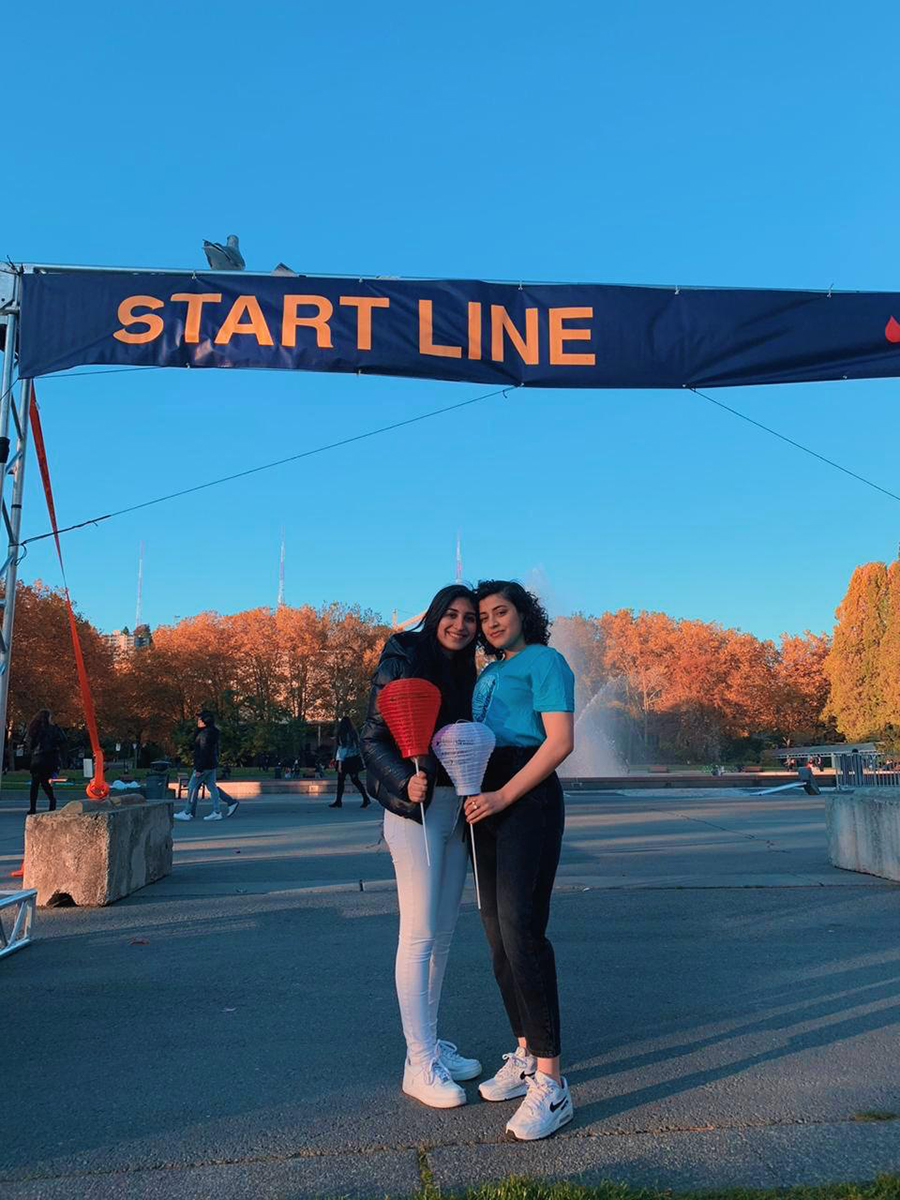
Maha, holding the red lantern, and her friend at a Light the Night walk organized by the Leukemia and Lymphoma Society. Cancer survivors carry red lanterns and their supporters carry white lanterns. Photo taken pre-pandemic. // Photo courtesy of Maha Alhomoud
Throughout her sophomore year, Alhomoud debated majoring in engineering — the more straightforward career path — or political science. “I’ve had people tell me that there wouldn’t be many opportunities for women in political science in Saudi Arabia,” explains Alhomoud. “But, through my diagnosis and my own experiences, I realized that for me, the most important thing was to speak my truth and pursue my passions. Going from there, I decided that regardless of the obstacles that I would face as a woman, I would still pursue political science. And, today in Saudi Arabia, there are continuously new and exciting opportunities for Saudi women to participate in policymaking and politics.”
Political science and international student advocacy work become the new hallmarks of Alhomoud’s Husky experience.
Finding a home 7,000+ miles away from home
Back to that first day of school. She attended classes after spending the night in the emergency room due to difficulty breathing. The ER doctors strongly suspected cancer. As soon as they say this, Alhomoud senses it’s true, though the specifics of the diagnosis still needed to be confirmed. After her political theory class ended, Alhomoud shared the impending diagnosis with Associate Professor Emeritus Christine Distefano who responded, “Can I give you a hug?”
“This was my first time feeling welcomed on campus,” remembers Alhomoud. “Professor DiStefano’s warmth was reflected in the rest of the political science department. I felt I had found my home.”
Professor DiStefano continued to champion Alhomoud throughout her freshman year, inviting her to participate in an upper-level seminar. “As we got to know each other, we talked more about where I came from and what opportunities were available to me on campus. She also gave me a few books written by scholars about women in the Middle East, which gave me the confidence to incorporate my background and interests into my own work.”
As Alhomoud continued her studies, she met several political science professors who worked in Middle Eastern politics; several of whom had done extensive field work. They encouraged her to take graduate level classes, apply for departmental honors and participate in the Center for American Politics and Public Policy program. This gave Alhomoud a platform to deepen her understanding of the ways her home country’s economy, religion, language and politics have established the current state, and how they will continue to factor in as Saudi Arabia pursues its Vision 2030 transformation program to diversify its economy and improve the standard of living for its citizens.
Learning how to turn research into meaningful policy
Alhomoud’s departmental honors thesis examines the evolution of extractive and distributive institutions in Saudi Arabia since its establishment. “By studying how political, economic and social forces shape the institutions found in the Kingdom today, I am hoping that my future work enables me to evaluate current policies and predict which policies can strike a balance between ensuring economic diversification and inclusive reform that provides opportunities for every citizen.”
Her goal is to leverage her research into policy that shapes the development of sustainable, inclusive and progressive healthcare and employment policies, particularly for those from groups that are disproportionately marginalized in the Middle East. This work represents a bridge between Alhomoud’s studies at the UW and her next step as a junior fellow at the Carnegie Endowment for International Peace Middle East Center.
The Carnegie Gaither Junior Fellowship is a highly competitive program in which Alhomoud will join approximately 12 other students from across the country to work alongside the Foundation’s senior fellows. She’ll sit in on meetings with politicians, assist in research, contribute to their publications and get a firsthand view of how research becomes policy that benefits peoples’ lives.
“With the Carnegie Endowment, most of the scholars are experts in the region and have done extensive field work there,” shares Alhomoud. “I’m thrilled to be working in an environment where there is a shared experience of being Middle Eastern and where there is a focus on local narratives, citizen perspectives and incorporating primary Arabic sources.”
Undergraduate research project: Corruption, Foreign Direct Investment, and Tax Revenue: Survival and growth of the World’s Oil-Rich Nations
Maha presented her research at the 2020 Undergraduate Research Symposium. Watch her presentation: https://youtu.be/RotAK9gaSho
Leading the way to the ASUW’s first international student office
Student government wasn’t something Alhomoud grew up with in Saudi Arabia. She was unaware it existed until a friend introduced her to ASUW her junior year. As she became involved in the UW’s student government, she saw an opportunity for better representation of international students. She co-founded the International Student Advocacy Group at UW and worked to give voice to the unique experiences and needs of international students. The advocacy group surveyed 270 international students to see if they were interested in having an ASUW office. A resounding 94.9% said yes.
In 2020, Alhomoud earned a Mary Gates Leadership Scholarship to form a task force to establish the first ASUW Office of International Student Advocacy led by students, for students. This marks the first time in ASUW history that international students have had a permanent voice and home in ASUW.
Mary Gates Endowment Leadership Scholarship project presentation: ASUW Office of International Student Advocacy
https://www.youtube.com/watch?v=G0lEYbyA3Aw
Representation for this diverse group of students matters. International students make up 15.5% of the UW’s student population and come from more than 100 countries. Some, like Alhomoud, are sponsored by their home government; some are refugees and asylum seekers; some want to return to their home countries after graduation; some are DACA recipients and others are hoping to immigrate to the United States. This diversity means there are many needs to represent in student government: financial, language barriers, representation and advocacy on campus, post-graduate career support and visa support.
Alhomoud graduates this spring and has worked this year to build the office’s foundation so it’s ready to launch next year. She’s defining the mission statement and goals, positioning the office within ASUW, determining the budget, creating job descriptions, and building relationships with long-standing campus entities that also serve international students. She’s building infrastructure to make sure needs are regularly assessed through constituent surveys and to build community and deepen cross-cultural understanding.
“I’m a little sad that I won’t be here to see the office kickoff its first year,” shares Alhomoud. “But I’m very happy that I’m going to graduate knowing that I created a tangible impact on our campus that will benefit international students and the broader UW community for years to come.”
Alhomoud is now three years into remission and reflects: “Freshman-year-me lying in the hospital never thought I would see myself being listed as a graduate with honors, and I cannot be more thankful for my family who supported me throughout treatment and my entire life.”
Maha Alhomoud, Class of 2021!
After completing her Carnegie fellowship, Alhomoud plans to pursue a dual degree program, earning a masters degree in political science and a law degree. From there, she hopes to create opportunities for women in politics in Saudi Arabia and that “her work contributes to a more nuanced understanding of the Middle East, and leads to more inclusive reform as countries diversify beyond oil, with a focus on sustainability.”
On Friday, May 21, nearly 750 undergraduates from all three University of Washington campuses as well as local community colleges and regional colleges will participate in the 24th Annual Undergraduate Research Symposium, which will be held online for the second year. The UW’s Undergraduate Research Symposium is one of the largest in the country and provides a professional opportunity for undergraduates to present their research, scholarly and creative work.
Registration is required to attend the virtual Symposium. To register, visit symposium.uw.edu. Attending the event is always free. Pre-recorded presentations followed by a live Q&A will happen in real time and will not be available for later viewing.
Undergraduates from all disciplines show the ways their research connects to issues that matter in our communities and contributes to the University’s work as a leading public research university. In 2019-20, nearly 8,300 students participated in at least 1 quarter of research. More than 1,200 students presented their work in the 2019 Undergraduate Research Symposium, and over 850 students presented in the virtual Symposium in 2020.
This year is the fifth year that the UW’s Population Health Initiative is awarding select student presenters a Population Health Recognition award for “their innovative and well-presented research work.” Among this year’s 12 student awardees are these timely and challenging research projects:
Dancing Around the Point: Addressing Vaccine Hesitancy amid the COVID-19 Pandemic in the Puget Sound Region by Annette Mercedes, who’s majoring in anthropology and biology.
Ultrafine Particle Inequality by Race, Ethnicity, and Income in Seattle by Kaya Bramble, who’s majoring in industrial engineering.
Firearm Injury and Violence Research Articles in Health Sciences by Funding Status and Type: A Scoping Review by Pavithra Prabhu, who’s majoring in microbiology.
“The application of classroom concepts in problem solving and experimentation have made me a better student, a better learner, a better teacher, a better thinker, and a better person. I believe every student, no matter the field, should conduct a mentored internship/research project in their area of study.”
— 2020 Symposium Presenter
Overview of the format and registration
Support student presenters through social media. Add a special frame to your Facebook profile pic; download graphics and post about it. Change out your Zoom picture and background for the Symposium.
The Symposium begins at 9 a.m., Pacific Daylight Time, and will run to 5:00 p.m. UW President Cauce, Provost Mark Richards and UAA Vice Provost and Dean Ed Taylor have each recorded videos to welcome students and guests; congratulate undergraduates on their accomplishments; share who the recipients of the Research Mentor Awards are; and recognize the invaluable role mentors play in encouraging undergraduates to transform their education through research.
Students will present their research in one of these formats, all followed by a question and answer period:
Lightning talk presentation,
10-minute oral presentation,
Visual arts and design presentation, or
Performing arts presentation
Registered guests will be able to access students’ abstracts and presentation times, watch presentations by students they specifically want to see, and explore and attend multiple sessions.
All presentations will be pre-recorded and played in real time, according to the event schedule; they will not be available for later viewing. Registration is required to attend this free event.
To view the sessions, register for the Symposium and make sure to set up a Zoom account if you do not already have one. Information about how to access the sessions and a detailed Symposium conference schedule will be emailed to registered attendees the week of Symposium.
Maha Alhomoud, a University of Washington senior majoring in political science, has been selected as a 2021-22 Junior Fellow by the Carnegie Endowment for International Peace. A highly competitive award, only 5% of applicants are selected for the Carnegie Gaither Junior Fellows program each year. The Carnegie Endowment for International Peace is a unique global network of policy research centers in Russia, China, Europe, the Middle East, India and the United States. Its mission is to advance the cause of peace through analysis and development of fresh policy ideas and direct engagement and collaboration with decision-makers in government, business and civil society. Alhomoud will join the Middle East program.
Fellows work alongside the Carnegie Foundation’s senior researchers and also have the opportunity to join meetings with high-level officials and contribute to the Foundation’s publications. In addition, as a full-time employee of the Foundation, they receive an annual salary and a generous benefits package. For Alhomoud, who is passionate about turning research into meaningful public policy, this opportunity is a chance to see how research is used to form policy, and how that policy goes on to impact people’s lives. She hopes her work impacts the development of sustainable healthcare and employment policies, particularly those from groups that are disproportionately marginalized in the Middle East.
Alhomoud is an international student from Saudi Arabia. She has always been interested in examining the contextual factors that create unique political systems in different countries, especially in the Middle Eastern context, leading her to focus on studying political economy. She is interested in studying resource reliance, authoritarianism and state-society relations in the Gulf Cooperation Council (GCC) states as they relate to political economy and comparative studies. Alhomoud is currently working on her political science honors thesis, supervised by Professor Whiting. Alhomoud’s work explores the evolution of extractive and distributive institutions in Saudi Arabia, specifically as they relate to taxation, and how the introduction of extractive policies impacts state-society relations. As the country is undergoing rapid change per its economic diversification roadmap, VISION2030, employing a process-tracing methodology has helped her understand the intersection between politics and economics.
Previously, as an undergraduate fellow for the Center for American Politics and Public Policy (CAPPP), Alhomoud designed a project concerning corruption, foreign direct investment and economic diversification in a panel study of 17 major oil exporters over time. She is also currently an undergraduate research assistant in the political science department to Kenya Amano, Ph.C., where she’s working on a project about central bank independence.
In addition to her academics, Alhomoud advocates for increased international student representation at the university level. This year, she earned a Mary Gates Leadership Scholarship to establish the first ASUW office dedicated to international student advocacy. For this project, she’s leading a team of 15 people to determine the new office’s mission, structure, budget and program. She is also a mentor for the International Student Mentorship Program (ISMP) at UW.
In the next few years, and especially as venues for Saudi women in the political sphere are increasing, she wants to learn more about the conduct of foreign affairs at the government level in Saudi Arabia and the GCC. During this time, she also plans to explore and rely more on local archives and works produced in the region for independent research projects. Long term, Alhomoud’s goal is to pursue a dual-graduate degree in law and political science and attain a membership in the Consultative Assembly of Saudi Arabia. Ultimately, she hopes her work “contributes to a more nuanced understanding of the Middle East and more inclusive reform as countries diversify beyond oil to address the impacts of different policies on different segments of society, especially those who are disproportionately affected.”
A feature story about Alhomoud will be coming soon.
About the Carnegie Gaither Junior Fellows Program
The James C. Gaither Junior Fellows Program at the Carnegie Endowment for International Peace is designed to provide a substantive work experience for students who have a serious career interest in the area of international affairs. Approximately 12-14 students will be hired to work as employees at Carnegie in Washington, DC on a full-time basis for a period of one year. Gaither Junior Fellows provide research assistance to scholars working on Carnegie Endowment’s projects. They are matched with senior associates – academics, former government officials, lawyers and journalists from around the world – to work on a variety of international affairs issues. Junior Fellows have the opportunity to conduct research for Carnegie publications, participate in meetings with high-level officials, contribute to congressional testimony and organize briefings attended by scholars, journalists and government officials.
About the Office of Scholarships, Fellowships and Awards
The Carnegie Gaither Junior Fellow application process is supported by the Office of Merit Scholarships, Fellowships and Awards (OMSFA), a UAA program. OMSFA works with faculty, staff and students to identify and support promising students in developing the skills and personal insights necessary to become strong candidates for this and other prestigious awards. The UW campus application process for students interested in Carnegie Junior Fellowship (and other scholarships supporting graduate studies around the world) will get started this spring for 2022-23 awards.
University of Washington junior Sophia Carey was recently selected for the Beinecke scholarship! Carey, who is majoring in English and comparative history of ideas and minoring in theatre studies, was selected from 95 applicants to join this year’s class. Each year the Beinecke Scholarship offers 20 scholarships to undergraduates who intend to pursue a master’s or doctoral program in the arts, humanities or social sciences. The selected students receive $30,000 to be used for graduate study and $4,000 in their senior year. The last time a UW student received this award was 2011.
Carey entered the UW through the Early Entrance Program at the Robinson Center for Young Scholars and has since focused her interdisciplinary studies in the arts, humanities and social sciences into a passion for community-based theater and the intersections between public policy and the performing arts. She is also in the Interdisciplinary Honors Program.
Research and leadership experiences have been hallmarks of her time as a UW student. Her past research includes the paper “Performing Beyond Utopia,” which explored how residents of Lima, Peru, in the 1970s used community-based theater to resist and transcend dictatorial state agendas. Outside of performance studies, Sophia’s research has been featured in an open glossary of law, society and justice terms, and in 2019, she won the UW Library Research Award for Undergraduates for her paper investigating barriers to Latin American youths’ access to educational support services.
Sophia is currently the president of the Early Entrance Drama Society, a student-run drama club at the UW. In almost three years of involvement in the club, she has co-facilitated the translation of a 2020 production into a virtual format, performed in and directed several productions, and hosted drama-related events designed to build community and provide performance opportunities for students interested in arts and arts leadership. In addition to her work with the Early Entrance Drama Society, Sophia has acquired significant experience with local nonprofit and community-directed theater, as a directing intern at Stone Soup Theater, a development assistant at ArtsWest, and currently as a volunteer at the Seattle Rep.
She plans to continue studying the potential for community-based theater to bring about material and political change through graduate research in a Ph.D. or MFA program that combines practical approaches and critical scholarly research methods in the study of theater.
About the Beinecke
The Beinecke Scholarship program is open to juniors in studying the arts, humanities and social sciences. The scholarship provides funding for students to pursue a masters or Ph.D. in these fields. Since 1975 the program has selected more than 664 college juniors from more than 110 different undergraduate institutions for support during graduate study at any accredited university.
About the Office of Merit Scholarships, Fellowships and Awards
The Beinecke application process is supported by the Office of Merit Scholarships, Fellowships and Awards (OMSFA), a UAA program. OMSFA works with faculty, staff and students to identify and support promising students in developing the skills and personal insights necessary to become strong candidates for this and other prestigious awards.
Each and every Husky goes through their own journey, undergoes their own unique experiences and, most importantly, has their very own story to share. Husky Stories is a mini-series in which Huskies share their successes, failures, experiences — their stories. There is no one way to be a Husky. Indeed, the culmination of individuals’ stories shape the picture of what it means to be a Husky.
“It can be a very intimidating process, especially because college there’s so many people here and just you know putting yourself out there in front of a bunch of people you don’t know, that can be very nerve-wracking. Try things that you’ve never done before. You might find that you’re really, really passionate about something that you’ve just never tried before. Yeah, just just don’t be afraid to do.”
Each and every Husky goes through their own journey, undergoes their own unique experiences and, most importantly, has their very own story to share. Husky Stories is a mini-series in which Huskies share their successes, failures, experiences — their stories. There is no one way to be a Husky. Indeed, the culmination of individuals’ stories shape the picture of what it means to be a Husky.
Welcome to the very first episode of Husky Stories! Ryan Lowery is majoring in math and atmospheric sciences here at the University of Washington. Other than school, Ryan is also involved with the Resilience Lab, a program within Undergraduate Academic Affairs. Here, he shares his stories of dealing with failure and resiliency. (Note: This interview took place prior to the coronavirus pandemic.)
The Resilience Lab is a campus partner in the Husky Health & Well-Being initiative. If you would like to talk with a counselor or simply learn more about the mental health resources available to students, visit the Husky Health & Well-Being website.
This week, the University of Washington’s Resilience Lab released the Well-Being for Life and Learning Guidebook, a new resource for instructors to aid them in designing learning environments that promote well-being. Combining research, best practices and personal testimony, the guidebook gives faculty and other instructors concrete ideas and direct input from the campus community around supporting the whole student and promoting resilience and compassion on campus.
Students’ well-being has been a growing concern for several years and has been exacerbated by 2020’s COVID-19 pandemic, economic fallout and the national reckoning over race and policing. A recent survey by the American Council on Education found that campus mental health was the top concern of university presidents.
“As we prepare the next generation of citizens and servant leaders, future educators, researchers, entrepreneurs and more, it really is critical that we incorporate practices that support our students’ whole lives and lived experiences,” says Ed Taylor, vice provost and dean on Undergraduate Academic Affairs. “As a public research university, much of our work is focused on understanding the factors that contribute to resilient communities. This guidebook helps us with that work right here at our UW home, knowing that it expands beyond campus as we all interact with our broader community through research, service and teaching.”
The guidebook’s Foundations for Advancing Student Well-Being are the framework for the guide and include the themes of teaching for equity and access, building resilience coping skills, nurturing connection and connecting to the environment. This framework promotes core skills and mindsets of social and emotional learning and draws on best practices modeled at other institutions. This resource was researched, developed, co-written and edited by the Resilience Lab team and more than 40 Well-Being for Life and Learning Fellows who are faculty members, instructors, staff and students across disciplines and from all three UW campuses. Their contributions give the guidebook a UW-focused, holistic perspective on the impact of teaching the whole student. In that way, the guidebook is both a call to action and an invitation to the work of helping students develop the tools and habits for well-being so they are mentally and emotionally equipped to learn and thrive.
“All of us at the Resilience Lab are so honored to have worked on this guidebook with such a committed group of instructors, staff and students,” says Resilience Lab Director Megan Kennedy. “We know that advancing student well-being really takes all of us, so our goal was to create a tool for our campus colleagues to add to their pedagogical toolbox. We wanted to give instructors a foundation of both why this work matters and how they can incorporate it into their teaching no matter where they are in terms of personal and professional experience.”
Support resilience, compassion and well-being
The Resilience Lab promotes well-being at the University of Washington through education, research partnerships, and core programs and initiatives.
The Well-Being for Life and Learning guidebook sits at the prevention and promotion end of a mental health continuum of care within the UW and is aimed at preventing larger issues or crises by bolstering students’ resilience coping skills and helping them respond to stress and stay connected to others. It’s a part of the Resilience Lab’s Well-Being for Life and Learning initiative, one of the Lab’s efforts toward building and sustaining a culture of well-being at the UW.
About the Resilience Lab
The Resilience Lab was founded in 2015 and is a program within Undergraduate Academic Affairs that promotes well-being at the UW through education, research partnerships and core programs and initiatives.
For more information about the Resilience Lab or its Well-Being for Life and Learning initiative and guidebook, contact Megan Kennedy at meganken@uw.edu.
Our inter-connected and inter-dependent community is filled with people who care, and I want to remind everyone to find moments of joy and gratitude in each day.




 Maha Alhomoud, a University of Washington senior majoring in political science, has been selected as a 2021-22 Junior Fellow by the Carnegie Endowment for International Peace. A highly competitive award, only 5% of applicants are selected for the Carnegie Gaither Junior Fellows program each year.
  University of Washington junior Sophia Carey was recently selected for the Beinecke scholarship!