Join students, faculty, staff and the broader UW community on May 20, 2022, as we celebrate the 25th Annual Undergraduate Research Symposium. Engage in conversations surrounding the problems and questions of our times. Gather for innovative research that matters most to you.
Tag: scholarships
UW sophomore Alex Mallen and junior Sharlene Shirali selected for the Goldwater Scholarship
Congratulations to University of Washington sophomore Alex Mallen, a computer science major, and junior Sharlene Shirali, a neuroscience major, whom the Goldwater Foundation honored with its undergraduate scholarship for students studying the natural sciences, mathematics and engineering. Mallen and Shirali join 417 undergraduate students selected for the award from a pool of 1,242 students nominated by 433 institutions across the country.
Celebrating the 2020–21 Undergraduate Medalists
From the thousands of undergraduate students at the University of Washington, three are selected each year for the prestigious President’s Medalist Award.
Piper Coyner, Olivia Brandon and Catherine Chia are the medalists for 2020–21, selected by a committee for their high GPAs, rigor of classes and numbers of Honors courses. All three are students in the University Honors Program, completing the Interdisciplinary Honors track.
Each medalist has carved a unique path at the UW, but they’re united in their passion for their chosen areas of study, ranging from neuroscience to anthropology to film studies. They’re also dedicated to giving back to the community, in both their extracurricular activities and their post-graduation career plans.
The students will be recognized by University President Ana Mari Cauce and Provost Mark Richards at a special reception, where each recipient will receive their medal in front of family, friends and mentors.
Read on to learn how these exceptional students embody the Husky Spirit.
Piper Coyner, junior medalist
Majors: Near Eastern studies–languages and cultures; cinema and media studies
Hometown: Olalla, WA

The moment Piper Coyner learned that the UW had a Near Eastern studies major, she knew she wanted to become a Husky. Since childhood, her dream had been to study the Middle East — and she was thrilled she could do it so close to home.
At the UW, Coyner has been able to dive into many aspects of Middle Eastern culture, history and language, studying Persian and Arabic. She has also discovered a second major in cinema and media studies, thanks to her involvement with the UW Film Club, where she leads a team of 20 writers. When she’s not exploring a canon of classic films or writing reviews, she’s an avid reader who enjoys contemporary fiction and history.
Whether focused on the screen or the pages of a book, Coyner takes inspiration from “stories of perseverance and self-sacrifice, of people caring deeply for others and making change in the world.” It’s with this model of making a difference that she hopes to attend law school after graduation.
For Coyner, who was also recognized in 2020 as a freshman medalist, this award is an important validation of her passion for and pursuit of the humanities.
“I often compare myself unfavorably to those in STEM and buy into the narrative that my work is not as important,” Coyner says. “This award shows me that’s not true — that students who study arts, cultures and languages are just as valued.”
Olivia Brandon, sophomore medalist
Majors: Neuroscience and public health–global health
Hometown: Seattle, WA

Olivia Brandon became fascinated with the study of human physiology during an introductory survey class — and that has shaped her UW journey.
Realizing her true passion, she packed her schedule with chemistry, biology and global health classes. She landed on neuroscience after learning about brain pathology as a research assistant in UW Medicine’s Neonatal Neuroscience Lab.
In her research role, Brandon works closely with UW faculty to help develop treatments for babies at risk for encephalopathy. “Being able to ask a scientific and medical question, create the database, extract the necessary variables, analyze the data and convey the information has sparked the scientist in me,” she says. Later this spring at the 2022 Pediatric Academic Societies medical conference, she plans to present a research project she spearheaded.
Inspired by her lab mentors and her physician parents, Brandon plans to attend medical school after graduation.
“I hope to become a physician who has an impact on improving people’s health, but I also want to be an advocate for improving equity in global and public health systems,” says Brandon, who is also majoring in public health–global health. During her first year at the UW, Brandon gave a TedX talk about the importance of addressing global issues like climate change.
As an animal lover, Brandon is also president of the UW equestrian team and has raised funds and volunteered for an equine rescue and rehabilitation center.
Catherine Chia, freshman medalist
Hometown: Redmond, WA
Majors: Biochemistry, neuroscience and anthropology

Catherine Chia got a firsthand look at the UW’s Seattle campus — and its many opportunities — when her older brother became a Husky. That glimpse helped shape her decision to attend the UW.
With a goal of attending medical school, she found herself naturally drawn to studying biochemistry and neuroscience.
“I love the mechanistic nature of both subjects, where I can learn to look for sources of a disease from the tiniest mechanisms of the body,” explains Chia, who is balancing her two science majors with anthropology. That subject serves as “an important reminder that innovation and development should always be aimed at helping others.”
Outside the classroom, she’s an undergraduate research assistant in Prof. Jonathan Posner’s lab, which is developing a diagnostic test for hepatitis C. The supportive community of the lab has built Chia’s confidence as a scientist and made her feel more at home at the UW.
Chia’s volunteer work includes helping elementary school students develop reading skills, leading summertime science activities at the Pacific Science Center and mentoring her fellow students in the UW Honors Program. As a future physician, Chia hopes to improve people’s lives in a holistic way. She’s passionate about rectifying education disparities and plans to continue volunteering in learning spaces.
“Receiving this honor is not just for me,” Chia says, “but also for everyone who has been there for me along the way.”
A subject to love, a determination to speak her truth
The diagnosis came on her first day of fall quarter. Cancer. Maha Alhomoud, newly arrived from Saudi Arabia had two options: Return home for treatment or stay in Seattle, attend the University of Washington and receive cancer treatment in the states.

Alhomoud’s goal of attending university abroad began when she was 12 years old. She bolstered her admissions chances through summer programs, robotics competitions, independent study programs such as the Saudi Research Science Institute (SRSI) at King Abdullah University for Science and Technology (KAUST), and had a strong educational foundation in STEM, thanks largely to the King Abdulaziz and his Companions Foundation for Giftedness and Creativity, known informally as Mawhiba. She studied English in school from a young age and prepared for a career in STEM, most likely mechanical engineering. Yet participating in Model United Nations piqued her interest in international relations. Throughout these Model UN conferences, she represented Iran, France, South Korea and Bahrain and valued the broad perspective this gave her. She got her first taste of using her voice to drive change through participating in Toastmasters.

This strong foundation in math, science and international relations had Alhomoud considering a double major in engineering and political science when she first came to the UW. But the diagnosis meant she’d be splitting her time between the hospital and class, making it difficult to take any lab classes. Even so, she continued preparing for a possible career in both fields, taking math and political science courses.
She received treatment in Seattle throughout her freshman year. Her dad, who initially came just to help her move, stayed for the next 12 months to care for her. That year consisted of eight months of an intensive chemotherapy regimen, additional medications, hair loss, chronic pain and weakness, plus additional conditions — all while going through her first year of college.
“I was constantly studying at the hospital listening to my lectures that were recorded specially for me, and immersed in my studies,” recalls Alhomoud. “In a way, it was a distraction from my illness and in studying political science, I had found subjects that I truly loved and enjoyed studying, even throughout the most traumatic experience of my life.”
Finally, good news: The cancer went into remission and the treatments were complete.
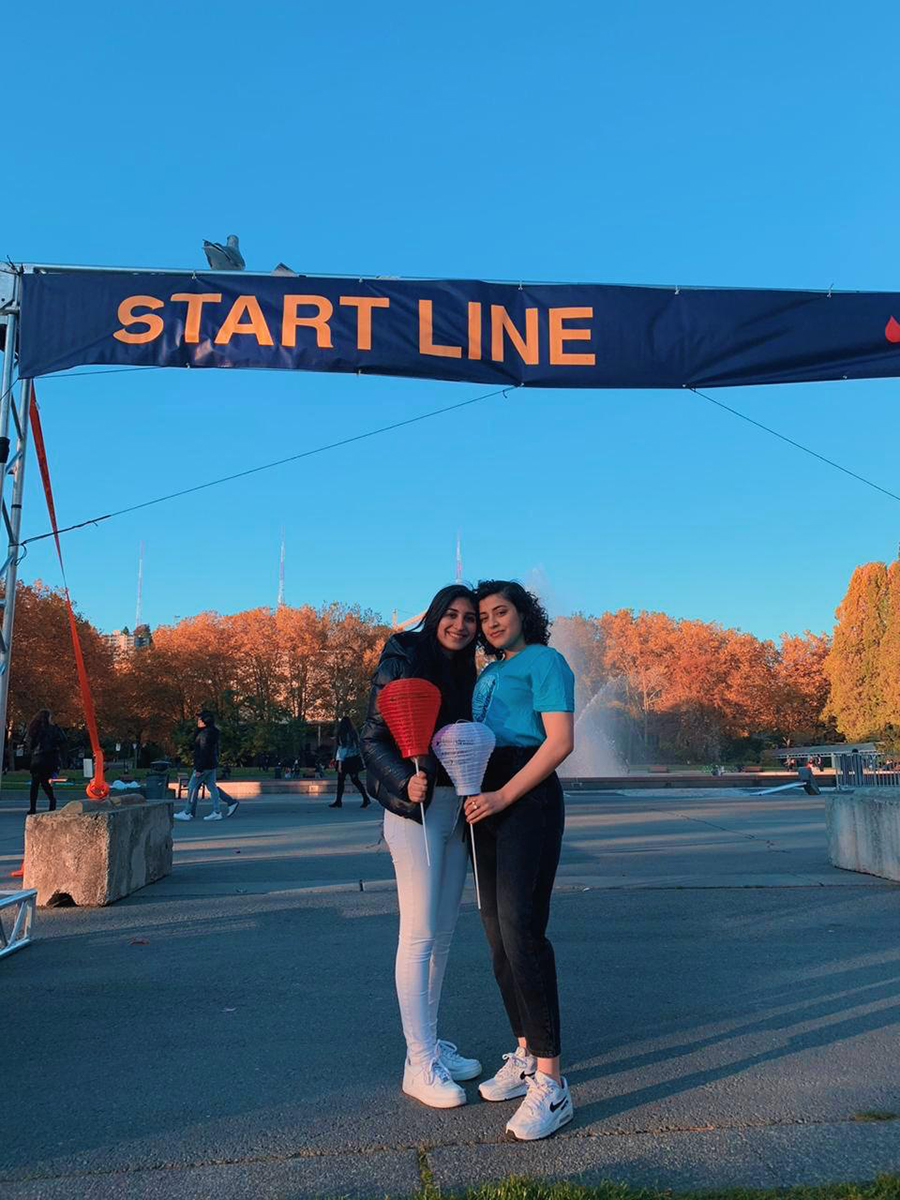
Throughout her sophomore year, Alhomoud debated majoring in engineering — the more straightforward career path — or political science. “I’ve had people tell me that there wouldn’t be many opportunities for women in political science in Saudi Arabia,” explains Alhomoud. “But, through my diagnosis and my own experiences, I realized that for me, the most important thing was to speak my truth and pursue my passions. Going from there, I decided that regardless of the obstacles that I would face as a woman, I would still pursue political science. And, today in Saudi Arabia, there are continuously new and exciting opportunities for Saudi women to participate in policymaking and politics.”
Political science and international student advocacy work become the new hallmarks of Alhomoud’s Husky experience.
Finding a home 7,000+ miles away from home
Back to that first day of school. She attended classes after spending the night in the emergency room due to difficulty breathing. The ER doctors strongly suspected cancer. As soon as they say this, Alhomoud senses it’s true, though the specifics of the diagnosis still needed to be confirmed. After her political theory class ended, Alhomoud shared the impending diagnosis with Associate Professor Emeritus Christine Distefano who responded, “Can I give you a hug?”
“This was my first time feeling welcomed on campus,” remembers Alhomoud. “Professor DiStefano’s warmth was reflected in the rest of the political science department. I felt I had found my home.”
Professor DiStefano continued to champion Alhomoud throughout her freshman year, inviting her to participate in an upper-level seminar. “As we got to know each other, we talked more about where I came from and what opportunities were available to me on campus. She also gave me a few books written by scholars about women in the Middle East, which gave me the confidence to incorporate my background and interests into my own work.”
As Alhomoud continued her studies, she met several political science professors who worked in Middle Eastern politics; several of whom had done extensive field work. They encouraged her to take graduate level classes, apply for departmental honors and participate in the Center for American Politics and Public Policy program. This gave Alhomoud a platform to deepen her understanding of the ways her home country’s economy, religion, language and politics have established the current state, and how they will continue to factor in as Saudi Arabia pursues its Vision 2030 transformation program to diversify its economy and improve the standard of living for its citizens.
Learning how to turn research into meaningful policy
Alhomoud’s departmental honors thesis examines the evolution of extractive and distributive institutions in Saudi Arabia since its establishment. “By studying how political, economic and social forces shape the institutions found in the Kingdom today, I am hoping that my future work enables me to evaluate current policies and predict which policies can strike a balance between ensuring economic diversification and inclusive reform that provides opportunities for every citizen.”
Her goal is to leverage her research into policy that shapes the development of sustainable, inclusive and progressive healthcare and employment policies, particularly for those from groups that are disproportionately marginalized in the Middle East. This work represents a bridge between Alhomoud’s studies at the UW and her next step as a junior fellow at the Carnegie Endowment for International Peace Middle East Center.
The Carnegie Gaither Junior Fellowship is a highly competitive program in which Alhomoud will join approximately 12 other students from across the country to work alongside the Foundation’s senior fellows. She’ll sit in on meetings with politicians, assist in research, contribute to their publications and get a firsthand view of how research becomes policy that benefits peoples’ lives.
“With the Carnegie Endowment, most of the scholars are experts in the region and have done extensive field work there,” shares Alhomoud. “I’m thrilled to be working in an environment where there is a shared experience of being Middle Eastern and where there is a focus on local narratives, citizen perspectives and incorporating primary Arabic sources.”
Undergraduate research project: Corruption, Foreign Direct Investment, and Tax Revenue: Survival and growth of the World’s Oil-Rich Nations

Leading the way to the ASUW’s first international student office
Student government wasn’t something Alhomoud grew up with in Saudi Arabia. She was unaware it existed until a friend introduced her to ASUW her junior year. As she became involved in the UW’s student government, she saw an opportunity for better representation of international students. She co-founded the International Student Advocacy Group at UW and worked to give voice to the unique experiences and needs of international students. The advocacy group surveyed 270 international students to see if they were interested in having an ASUW office. A resounding 94.9% said yes.
In 2020, Alhomoud earned a Mary Gates Leadership Scholarship to form a task force to establish the first ASUW Office of International Student Advocacy led by students, for students. This marks the first time in ASUW history that international students have had a permanent voice and home in ASUW.
Mary Gates Endowment Leadership Scholarship project presentation: ASUW Office of International Student Advocacy
https://www.youtube.com/watch?v=G0lEYbyA3Aw
Representation for this diverse group of students matters. International students make up 15.5% of the UW’s student population and come from more than 100 countries. Some, like Alhomoud, are sponsored by their home government; some are refugees and asylum seekers; some want to return to their home countries after graduation; some are DACA recipients and others are hoping to immigrate to the United States. This diversity means there are many needs to represent in student government: financial, language barriers, representation and advocacy on campus, post-graduate career support and visa support.
Alhomoud graduates this spring and has worked this year to build the office’s foundation so it’s ready to launch next year. She’s defining the mission statement and goals, positioning the office within ASUW, determining the budget, creating job descriptions, and building relationships with long-standing campus entities that also serve international students. She’s building infrastructure to make sure needs are regularly assessed through constituent surveys and to build community and deepen cross-cultural understanding.
“I’m a little sad that I won’t be here to see the office kickoff its first year,” shares Alhomoud. “But I’m very happy that I’m going to graduate knowing that I created a tangible impact on our campus that will benefit international students and the broader UW community for years to come.”
Alhomoud is now three years into remission and reflects: “Freshman-year-me lying in the hospital never thought I would see myself being listed as a graduate with honors, and I cannot be more thankful for my family who supported me throughout treatment and my entire life.”

After completing her Carnegie fellowship, Alhomoud plans to pursue a dual degree program, earning a masters degree in political science and a law degree. From there, she hopes to create opportunities for women in politics in Saudi Arabia and that “her work contributes to a more nuanced understanding of the Middle East, and leads to more inclusive reform as countries diversify beyond oil, with a focus on sustainability.”
UW alumna Crysti (Zinan) Chen named Schwarzman Scholar
University of Washington alumna Crysti (Zinan) Chen, (’15, B.A. in political science) received the prestigious Schwarzman Scholarship. Selected from more than 4,700 applicants, Chen will join 145 Schwarzman Scholars from around the world to make up the program’s fifth cohort. A competitive program, the incoming class was selected through a rigorous application process designed to identify academic ability, as well as leadership potential and strength of character. The program takes place at Tsinghua University in Beijing, where the scholars will immerse themselves in Chinese culture, business and language. At the end of the cross-cultural, year-long program, scholars will have developed an in-depth understanding of China and earned a master’s degree in global affairs.

The core curriculum is focused on three pillars: China, global affairs and leadership. Scholars also have the opportunity to take elective courses from a variety of disciplines at Schwarzman College, as well as from other departments at Tsinghua University. Scholars are taught by a cadre of leading international faculty, with frequent guest lectures from prominent global thought leaders.
Beyond the classroom, Scholars gain exceptional exposure to China and access to important relationships through internships, mentors, high-profile speakers and opportunities to travel throughout China. Scholars are also provided with a range of career development resources to help them to make the most of their time in Beijing and position them for success upon graduation. This unique combination of coursework, cultural immersion and personal and professional development opportunities equip students with a first-hand and well-rounded understanding of China’s changing role in the world, critically important to leadership in any field in the 21st Century.
About Crysti (Zinan) Chen
Chen will graduate from the University of Pennsylvania in 2020 with an M.S.Ed. degree in education entrepreneurship. She obtained her bachelor’s degree in political science, with a political economy focus, and minored in international studies from the University of Washington. Chen founded her first nonprofit organization in 2009. She dedicated a decade in promoting education quality, gender equality, and environmental awareness in underprivileged villages in China, Vietnam and Kenya. In 2017, Chen co-founded UniWill Ventures in Silicon Valley. She currently serves as the general partner and leads impact investing into early-stage tech startups. As a Schwarzman Scholar, Chen hopes to explore more effective methods to leverage investment capital with goodwill to create bigger impact on urgent social and environmental issues.
About the Schwarzman Scholars Program
Designed to inspire the next generation of global leaders, Schwarzman Scholars is the most significant program of its kind since the Rhodes Trust was founded in 1902. The Schwarzman Scholars Program is in its fourth year as a new institution at Tsinghua University in Beijing. The program’s focus is global leadership and draws students from China, the U.S. and the rest of the world. Over the course of the year, students will spend a quarter immersed in language: Mandarin for non-Chinese students; English for Chinese students. They’ll complete an intensive field study, where they will spend a week in communities throughout China, working with mentors from NGOs, academics and government; receive mentorship from prominent Chinese leaders; attend talks from high-profile speakers; and complete a practical training project, where they take on consulting-style projects. Scholars also have access to career services support to help them make the best of their time in Beijing, and receive ongoing support in the form of alumni events. The Schwarzman Scholars program is dedicated to building a strong alumni network, so that their students can continue to learn from and support one another. Last year, Henry Chan became the UW’s first Schwarzman Scholar.
The Schwarzman Scholarship application process is supported by the Office of Merit Scholarships, Fellowships and Awards (OMSFA), a UAA program. OMSFA works with faculty, staff and students to identify and support promising students in developing the skills and personal insights necessary to become strong candidates for this and other prestigious awards.
Two UW students honored by Goldwater Foundation
The Goldwater Foundation honored two University of Washington students this year. Selected from 1,223 nominees from across the country, undergraduates Chris Moore and Irika Sinha were named Goldwater Scholars.
UW named a Fulbright ‘top producing’ institution: spotlight on undergrads
These incredible undergraduates are part of the reason the University of Washington was one of 12 institutions to make the “top producers” list of both Fulbright scholars and students for 2014-15.
From mentee to mentor and beyond
Already on her way to a career in education, UW sophomore Meili Powell credits the Dream Project and the Pipeline Project with helping her find her way.
Navigating the scholarship process

The world of scholarships can be a daunting one. The Office of Merit Scholarships, Fellowships and Awards (OMSFA) helps undergraduates foster the skills and vision that are necessary to attain scholarships fit for their goals. Here, Mona Pitre-Collins, director of OMSFA, Robin Chang, assistant director of OMSFA and Sara Stubbs, global opportunities adviser, answer some common questions regarding the scholarship process.
Q: If a student is interested in applying for scholarships, what’s their first step? What should they be doing to make themselves competitive applicants?
Sara Stubbs (SS): When I meet with students, a distinction I often start with is high school versus college level scholarships. In high school, students would write an essay and get some cash. At this level, scholarships are often designed to pursue a particular endeavor, such as study abroad or research. The first step is really for students to develop their interests by using their resources, academic or otherwise. At that point it becomes a bit easier in a meeting with one of us to determine the kinds of opportunities that will help them support their endeavors. A student who comes in and says they just want some cash is very limited in the sense of scholarship searches.
Mona Pitre-Collins (MPC): Students should become engaged and they should use their academic work to develop a stronger understanding about the kinds of things they really want to do and the bits and pieces that will help them flesh that out and help them become stronger candidates, focused, more directed in relation to the goals they’re in the process of articulating. Sometimes the bits and pieces are developed in a nice plan, most other times they’re… not [laughs].
Robin Chang (RC): In order to widen the universe of scholarships you’re considering, you have to think beyond what will just put money in your pocket for school and see scholarships as facilitating gaining the experiences you need while in school to get a job, or go to graduate school or whatever comes later on after school.
Q: What are some benefits of applying for a scholarship, even if you are not selected to receive an award?
SS: The process really encourages students to think about and articulate their particular goals. When we start talking about what a student wants to get out of a particular scholarship opportunity, they end up figuring out even more goals for the future. Not only does fleshing out their plans make their application stronger, they’re also fleshing out their plans for what they want to do next. Without having been pushed to write that essay, they probably wouldn’t have thought that far.
MPC: Students have to develop a comprehensive way of talking about why they want to do this next endeavor, and applying for scholarships really helps with that.
RC: It also forces you to talk to and get to know your faculty members. You get a lot of relationship building going on.
Q: What is the number one thing that students overlook when they start applying for scholarships?
RC: The application component that applicants don’t spend enough time on is the resume. We see a lot of lists of activities completed, without any details or descriptions of what those activities were or what the student’s role was. I think a lot of people shortchange themselves on their resume because they think they don’t have a lot of stuff to put on there, but in reality they have more than they think.
MPC: Letters: how to approach someone to ask for a letter and materials they need to give a letter writer. A lot of students ask a faculty member or staff member to write a letter, but all they give them is the recommendation form. Even in high school, you have individuals that may not remember you that well. They can look in their gradebook, but that doesn’t say a lot about an individual.
SS: Exactly. A letter writer may know the student and know their work, but they may not know about the RSOs they’re involved in, any jobs they have, or any other circumstances in the student’s life. Students need to inform their letter writers.
Q: What are some common misconceptions students have when they come in to meet with one of you?
RC: It really does takes more than just having a good GPA. Some students come in with the thinking of “My high school GPA is a 3.96, why aren’t you giving me money?”
SS: I meet with a lot of students who don’t think they are candidates for any scholarships. When I meet with them initially they say they aren’t doing anything interesting, but when I talk to them it actually really is interesting that could fit with a particular scholarship.
MPC: A lack of scholarship availability. There are actually scholarships out there that are not as well populated; there aren’t thousands of people applying to them.
RC: Thinking that you have to wait to apply for scholarships when you need the money or when you’ve been accepted into a study abroad program. If you want to do something junior year you should be thinking sophomore year what your options are in terms of scholarships.
Q: What can students expect when they meet with you?
RC: We basically help them get started. We chat with them about what they were previously involved in, what they are involved in, what they hope to be involved in, and what tools are available to them.
SS: We help students brainstorm.
MPC: We’re also a door that opens students to other resources that might be available, such as scholarships in their own department or just good programs that help them become more competitive applicants for more scholarships.
The Office of Merit Scholarships, Fellowships, and Awards is one of many programs within Undergraduate Academic Affairs. OMFSA is located in Mary Gates Hall 171. To schedule an appointment regarding the scholarship process, contact OMSFA at 206-543-4282.
—Jasmine Kim is a sophomore in the University at Washington Honors Program majoring in cellular, molecular, and developmental biology with a minor in near eastern studies.
Explore scholarships at 2013 Scholarship Fair
Learn about and explore the variety of scholarships, fellowships, and other funded programs for undergraduate and graduate students as well as your post-graduate years.
Program representatives from UW, local and national organizations, agencies, departments, etc. will be tabling throughout the day, as well as offering specific workshops & information sessions.
The Scholarship Fair in Mary Gates Hall Commons runs from 10 a.m.-2 p.m.
Info sessions are held on various scholarships from 10:30 a.m.-5 p.m.
Scholarships are recognition of your past accomplishments and also investments in your future promise. This is a great opportunity to learn a lot about many opportunities!
The Office of Merit Scholarships, Fellowships and Awards is housed within the Center for Experiential Learning and Diversity and part ofUndergraduate Academic Affairs.