The 1960s
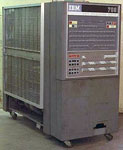
First computers used at UW. During the 1960s, computers gradually arrived at the UW. Some of the earliest were an IBM 650 on the top floor of Bagley Hall and an IBM 709 in the basement of the Mechanical Engineering building. The computers were described as having "an incredible number of vacuum tubes and massive air conditioning."
UW administrative data processing was done with punch card and tape-based systems running batch jobs on various mainframes during the 1960s and 70s.
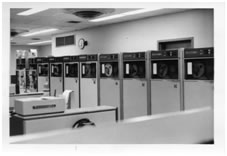
Photo by Sidney McHarg
In the mid-1960s, computer operations were moved to More Hall and Wilcox Hall (called Roberts Annex at that time).
In 1966, a Burroughs B5500 was installed in what is now Wilcox Hall to provide services for both administrative data processing and some student instruction. The machine provided both a multi-processing batch environment and the first time-sharing service on campus through a number of dialup connections on Model 33 TTY devices at 110 baud. The system was also the first to provide disk storage for user files. (The B5500 tape subsystem in the Roberts Annex/Wilcox computer center, circa 1970.)
By the end of the 1960s, there were still only five computer facilities at the UW: an IBM 1130 at oceanography, IBM 1401s at the Administration Building and at Harborview, and an IBM 7040/7094 and the Burroughs B5500 at Wilcox Hall. See a video of the 7040/7094 in action.
A WGBH/MIT video about early work on timesharing is available from YouTube. Information on UW computing in the 1960s and 1970s was provided by Jean-Loup Baer, Sidney McHarg, Ed Lazowska, and Hellmut Golde.
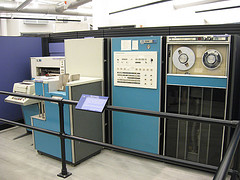
Graduate computer science degrees first offered. In 1967, the Computer Science Group (CSG) was formed to offer M.S. and Ph.D. programs in computer science. CSG acquired a Scientific Data Systems Sigma 5 computer in 1969 and housed it in Wilcox Hall. CSG expanded in 1975 to offer an undergraduate program as the Department of Computer Science, and expanded again in 1989 to add a computer engineering undergraduate program as the Department of Computer Science and Engineering.
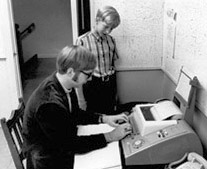
Lakeside School computer club connects. In 1968, using money from a Mothers Club rummage sale, Lakeside School set up an ASR-33 Teletype terminal for the school computer club. An eighth grader named Bill Gates used the terminal for his first experience in mainframe programming. The computer club was invited by a startup company named Computer Center Corporation (C^3), formed mostly of former UW employees, to test software in exchange for free programming time. Eventually, Gates and Paul Allen, also a Lakeside student, began using UW Medical center and Physics Department computers for free during their slack times at night and on weekends.
The 1970s

First compute-intensive research / instructional computing machine on campus. In the early 1970s, a Control Data Corporation CDC 6400 was acquired for compute-intensive research and instructional computing. Initially located in Wilcox Hall, the CDC was eventually moved to the new Academic Computer Center when it was built in 1980. Still relying on card decks, punch tapes, and magnetic tape for input and output, the CDC is described by some as a "computer designed by people who thought the valuable commodity was CPU time, not human time." The CDC computer, gradually updated and expanded over the years, would continue to play a major role in research and instruction at the UW until it was shut down and disassembled in July 1990.
In 1972, the Burroughs large system platform and its Master Control Program (MCP) operating system was selected to consolidate the UW administrative computing environment. One of the first systems implemented on the Burroughs was the Financial Accounting System (FAS), which became available in 1974. The hardware has been replaced several times, but most of the UW’s administrative systems still depend on the Burroughs (now Unisys) mainframe platform.
The 1980s
National computer networking comes to UW and the Northwest.In 1981, the Department of Computer Science became part of the ARPANET, a research network established by the government's Advanced Research Projects Agency. It was the predecessor to today’s Internet.
Comprehensive transaction processing data base systems were implemented, with online access through a dedicated administrative network connected to terminals. Systems that became available during this period included the Student Data Base (SDB), Higher Education Personnel Payroll System (HEPPS), Purchasing System (PAS) and Budget Systems (BGT). Many of these systems are still in use.
In 1986, the UW connects to NSFNET, the next step toward the modern Internet. NSFNET was set up by the National Science Foundation (NSF) to provide access to supercomputers in San Diego, Illinois, and elsewhere for heavy research computing. The Internet domain name “washington.edu” was registered on September 4, 1986. Part of the NSFNET initiative included creation of regional networks to provide connectivity between the national “backbone” and individual institutions within a geographic area. In 1987, the UW and nine other institutions formed the NorthWest Academic Computing Consortium (NWACC) and created "NorthWestNet" (NWNet), a regional network designed to link partner institutions in Washington, Alaska, Oregon, Idaho, Montana, and North Dakota to each other and NSFNET.
In 1987, the STAR telephone class registration system was launched. STAR was the UW’s first self-service administrative system, and enabled students to register for classes by themselves. Later, STAR was moved onto the Web, and now online course registration is available through MyUW.
In 1989, NWACC members asked the UW to take over operation of NWNet. Subsequently the UW formed and still operates its successor, the Pacific Northwest Gigapop. Originally constructed from commercial 1.5Mbps data links, the network now provides 10Gbps services linking partner institutions with commercial Internet carriers as well as the country's primary research networks, Internet2 and National Lambda Rail.
In the late 1980s, the UW merged all information technology organizations into a single unit, Computing & Communications (C&C). At the same time the University consolidated five separate computing networks into a single institution-wide network.
The 1990s
UW leverages Internet for nationwide research collaboration and data archive. During the 1990s, the Internet provided new opportunities for cooperative and distributed research. Examples are the Long Term Ecological Research (LTER) network and  Incorporated Research Institutions for Seismology (IRIS). LTER uses national networks to improve communication, cooperation, and information sharing among 17 research sites spread across the nation. IRIS maintains a massive data archive of seismological data from around the world for a consortium of 78 US universities.

1992: First public release of UW's “Pine” email program. Originally developed to replace a mainframe mail system serving a few hundred UW administrators, Pine became one of the most important productivity tools on the Internet, eventually used by tens of millions of people at thousands of institutions (educational, government, and commercial). Pine received numerous honors over the years, and along with UW's work on the Internet Message Access Protocol (IMAP) was the basis for a $100,000 technology collaboration award from the Mellon foundation in 2006. The freely available software was even used by Craig Newmark as a building block in his original CraigsList service. More information.
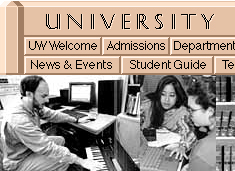
The UW Home Page officially goes online on December 23, 1994. In the first five weeks of its life, the site was viewed 25,000 times. See an early version of the UW Home page.
Birth of Internet2: The “Next-Generation Internet.” UW was one of 34 universities that banded together in the Fall of 1996 to develop the “Next-Generation Internet”. The goal was to jointly operate a nationwide research network designed to meet the high-bandwidth requirements of advanced applications and computational science. The result was Internet2, which in due course provided leadership not only in networking, but also identity and federated access management technologies. UW continues to be a partner and contributor to these efforts.
In 1998, the Advancement Office began the migration away from the Burroughs mainframe environment by implementing the BSR Advance client-server system to better support alumni relations and fundraising.
In the late 1990s, C&C developed middleware supporting a single user identification and password system to provide security and access control to most systems.

Y2K is coming. In preparation for the year 2000 (Y2K), administrative systems were modified and extensively tested to ensure continued functionality as the UW moved into the new millenium. Older versions of COBOL were converted to a modern version.
From 2000-2009
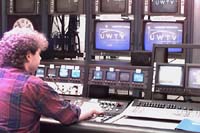
Photo by Rick Ells
World's first "HDTV over Internet" transmissions. After successful demonstrations of UW-developed video streaming software in late 1999, Sony Corporation showcased UW's technology at the spring 2000 meeting of the National Association of Broadcasters. UW engineers sent multiple concurrent streams of live, studio-quality HDTV from KING TV in Seattle to the Las Vegas convention center, for a combined flow of a billion bits per second, plus High Definition "Electronic News Gathering" streams back to Seattle. Partners in the experiment included Sony Electronics, Enron Broadband Services, Juniper Networks, Pacific Northwest Gigapop, KING-TV, and Electric Lightwave. More information.

The University Services Renewal (USER) project focused on streamlining UW administrative support services through the use of Web-based technologies. Some key products delivered during its lifespan include:
- Email Access for New Employees (Early Email, 2000)
- Employee Self-Service (ESS, 2000)
- Online Payroll Update System (OPUS, 2001)
- Online Work/Leave System (OWLS, 2002)
- MyFinancialDesktop Reporting (2005)
- UW Timesheet for hourly employees (2006)
- MyFinancialDesktop Transactions (2008)
Also during the 2000s, the Enterprise Data Warehouse was implemented, providing a central repository of the UW's electronically stored institutional data.

Live high definition video broadcast from ocean floor. During the 2000s, the UW led the way in demonstrating the potential for delivering high definition video over the Internet for education and research purposes. An example was the HDTV broadcast of ocean floor research by the Visions 2005 research expedition, co-led by UW's John Delaney. Scientists aboard the UW's Research Vessel Thomas G. Thompson used underwater robots and high definition video to explore undersea volcanoes off Washington's coast. More information.

Cloud Computing comes to UW. After extensive testing, contract negotiation, and integration with UW enterprise systems, Microsoft and Google cloud-based collaboration tools became available, initially to UW students and alumni, and subsequently to faculty and staff. More information. See a summary of current cloud services.
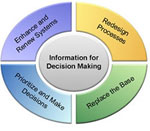
In 2008, the UW Strategic Roadmap for Information Management and Administrative Systems set forth a long-term vision and comprehensive plan for the future of UW information management and administrative systems. To learn more about the UW's current approach to implementing the Roadmap, see University of Washington Strategic Roadmap for Information Management and Administrative Systems - Update FY 2012, which includes an overview of initiatives, timelines, and future direction.