|
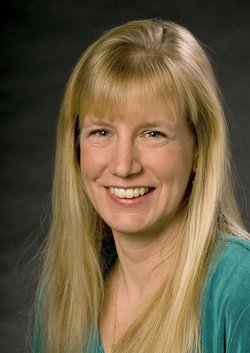
Denise Wilson Denise Wilson has never fit the stereotype of the thick-glasses-and-pocket-protector engineer. A welcome mat lies outside her office door. Inside are shelves are filled with plants and stuffed ladybugs. She's crazy about her dogs. But her efforts tying her academic interests to the aftermath of Hurricane Katrina have set her on a radical new path. "It's changed everything," said Wilson, the winner of this year's S. Sterling Munro Public Service Teaching Award.
In winter quarter of 2007, Wilson taught a fourth-year electrical engineering course titled The Impact of Katrina on Technology and Infrastructure. This wasn't for armchair academics. In January, 12 students left for Bay St. Louis, Miss., a small community on the Gulf Coast that had been hard hit by Hurricane Katrina. The students -- some of whom had never before ventured outside Washington state -- lived in dorms and wielded hammers and electrical tape to help rebuild destroyed homes.
The class met regularly to talk about broader issues that magnified the storm's effects. Each student wrote a technical paper addressing questions such as: Why did the entire state lose power? Why were so many people trapped? Why didn't search-and-rescue teams reach people in time?
Last summer Wilson brought 14 more students to Bay St. Louis for a three-week Exploration Seminar.
"The outcomes are messy, sloppy and really hard to measure," Wilson said of the classes. But she believes these immersive experiences are worthwhile despite the challenges.
"We have to engage the joy of students, not just the intellectual element," Wilson says. She's most happy, she says, when she sees "all the enthusiasm, all the jumping up and down. When students tell me, ‘Now I see how to go back and immerse myself in my degree.'"
Students reported that they learned practical skills and essay writing, all while seeing firsthand the long-term effects of a natural disaster.
"Prof. Wilson is on the forefront of the service learning movement in engineering," wrote department chair Leung Tsang in his nomination letter. While many professors are devoted to education, he notes, Wilson is exceptional. She earned a Master's degree in education and participated in a yearlong program at a nationally funded engineering education center.
The students' experiences on the Gulf Coast are recorded in a documentary, Learning from Katrina. Videographer Ella Kliger wrote in her nomination letter: "The impact on students was profound. My interviews with the students in Professor Wilson's course demonstrated that this creative mix of classroom work with volunteer opportunities was...contributing to shaping their worldviews."
Perhaps Wilson is able to inspire students because she leads by example. As a professor, she uses her research to help communities in need. Last year, she founded a nonprofit that develops environmental sensors to test the effects of Hurricane Katrina. Since last summer, Wilson has been back to the coast three times, measuring formaldehyde levels in FEMA trailers. Her device shows not just whether formaldehyde is present, but where it is found in the building.
Wilson's engineering classes at the UW are similarly tied to the real world. Students in her fourth-year design course must build a device to address a significant social problem. This spring, her students are working on projects that include a sensor that quickly detects harmful bacteria in drinking water, and a rain-snow sensor for use in the mountains to predict flooding.
In the midst of all this, Wilson and her husband still make time to organize and serve dinners at a homeless shelter. Her explanation of how she finds the time is typical of her outlook.
"I could say that serving dinner to homeless people once a month is good because it exposes us to more aspects of society," she said. "But really, we do it because it's in our hearts."
Her unconventional attitude may eventually spread to the halls of learning.
"We absolutely, for survival reasons, have to be out in the community with students more than we are," Wilson says. In future, she predicts, "our whole model of academics will change. I think greater links to the community will become part of how we operate as a university."
|
|||
|