|
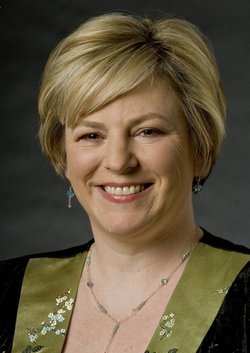
Robin Bennett Robin Bennett has been referred to as a "rock star" by UW Medical Center colleagues. It doesn't mean she's in a band, however. Instead, it's her expertise in genetic counseling that provides the high-profile status. Bennett is frequently on the public speaking circuit -- whether it's an appearance on NBC's Today Show or an upcoming talk in Saudi Arabia as a guest of the government. She even flew down to Los Angeles recently to film a show on genetic counseling for the Women's Entertainment TV network.
Bennett is quick to dispel the rock star myth and said her public speaking is aimed at raising the visibility of hard-working counselors. "I'm really honored because I feel that so few people realize what genetic counseling can do, and who genetic counselors are," she said. "It is important to take any reasonable opportunity to speak to the media and to be in that light."
Peter Byers, director of the UW Medical Genetics Clinic and professor in the departments of pathology and medicine, referred to Bennett in a nominating letter as "one of the most recognized genetic counselors in the country." (She serves as assistant director of the above-mentioned clinic and is also senior genetic counselor and clinic manager at UWMC.)
But Byers is also quick to point out that the nomination is based on more than public appearances. Bennett, he said, was instrumental in helping to expand the Medical Genetics Clinic, which now sees more than 1,400 families each year. This compares with numbers 10 to 15 years ago of 250 families each year. "Under her direction, it has become the largest adult genetics clinic in the country and the largest cancer genetics clinic devoted to adults in this type of setting," Byers said.
Gail Jarvik, professor in the Department of Medicine and head of the Division of Medical Genetics, described Bennett as a "sensitive and empathetic counselor" as well as an "outstanding administrator" in a nominating letter. "Her patients, who are often facing difficult and painful decisions, can rely on her to interpret complex medical information for them with compassion and understanding," said Jarvik.
Bennett has worked at the UW since 1984. She teaches human genetics to second-year medical students and served as a guest instructor in the Department of Genetics and Department of Medical History & Ethics. Bennett's Practical Guide to the Genetic Family History, now in its second edition, is used by counselors and medical geneticists around the world.
In person, Bennett is down-to-earth, affable and humble. Her philosophy about working in the realm of science is that she has a duty to not only use her mind for science, but to also apply that mind to real-life situations. What does that mean? Bennett said for her, it means doing the little things that you don't think are a big deal. She was inspired in the mid 1980s, for instance, to respond to a "Dear Abby" column in which the columnist gave off-base advice to a reader who said she was in love with her cousin. "I wrote back, and said you're wrong," said Bennett.
Bennett's letter to "Dear Abby" was published, and became the start of world-renowned research on genetic counseling and screening for consanguineous couples (related as second cousins or closer) and their offspring. The study got tons of media attention, and Bennett still speaks on the topic today. "I received nearly 1,000 e-mails, letters and phone calls from all over the world from people who appreciated the truth coming out," said Bennett. (The research showed the risk of things like birth defects was not as great as researchers and the general public thought.) "I felt it was important work even though people snicker about it."
The genetic counselor said she's honored to receive the Distinguished Staff Award. As a colleague put it, "the University of Washington is as big as some small countries," said Bennett, with a chuckle. "It shows how important genetic counselors are and the work that we do. I'm excited that, hopefully, this will bring attention to the work of genetic counselors."
|
|||
|