Access to Technology
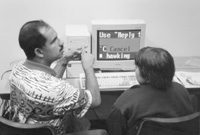
In order to make your Internet program accessible to all of your campers, consider issues related to the following:
- the facility
- the computers
- World Wide Web pages
Facility Access
In making your camp computer lab accessible, principles of universal design should be employed. Universal design means that rather than design your facility for the average user, consider a broad range of abilities and disabilities. Keep in mind that campers may have learning, visual, speech, hearing, and mobility impairments. Addressing the general access questions provided in the enclosed videotape and handout, each titled Equal Access: Computer Labs, will help assure that your facility is accessible to campers who use wheelchairs and have other mobility impairments, signs and labels can be accessed by those with visual impairments, and lab staff are prepared to interact with campers who have a broad range of abilities and disabilities. The handout also lists resources that can be used to help you address facility access issues.
Computer Access
People with disabilities face a variety of barriers to providing computer input, interpreting output, and reading documentation. Adaptive hardware and software have been developed to provide functional alternatives to standard operations. Campers with disabilities may be able to bring adaptive technology that they need to access computers in your lab. Or, they may be able to at least let you know what they need. The enclosed handout and videotape presentation, each titled Working Together: People with Disabilities and Computer Technology, provide examples of adaptive technology that allow people with disabilities to use computers.
In your camp you may not have enough warning to provide adaptive technology for a camper with a disability in your computer lab. If this is the case, to maximize participation, consider pairing them with someone who has a different or no disability. For example, a camper who is blind could be paired with a camper who cannot use his/her hands. The blind camper could type and manipulate the mouse; the camper with a mobility impairment could read the screen, describe the graphics, and guide the blind camper as they provide input. The bottom line is to maximize the participation of everyone.
World Wide Web Access
The World Wide Web has rapidly become the most popular Internet resource, combining hypertext and multimedia to provide a huge network of educational, governmental, and commercial resources. Yet, because of the multimedia nature of the medium, many Internet surfers cannot access some of these materials. Some visitors:
- cannot see graphics because of visual impairments
- cannot hear audio because of hearing impairments
- use slow connections and modems or older equipment which cannot download large files
- have difficulty navigating sites that are poorly organized with unclear directions because they have learning disabilities, speak English as a second language, or are younger than the average user
- use adaptive technology with their computer to access the Web
If you develop a Web site as part of your camp program, follow universal design principles to ensure that all Internet users can get to the information at your Web site regardless of their disabilities or the limitations of their equipment and software. Use the guidelines provided in the enclosed videotape presentation and handout, both titled World Wide Access, to ensure that your Web pages are accessible to a diverse audience. The handout also lists resources to consult for further information about developing accessible Web pages.
For more information about teaching strategies and making your program accessible, consult the DO-IT home page at www.washington.edu/doit.