Broadening Participation in Science and Engineering by Welcoming Participants with Disabilities

Prepared by AccessSTEM and DO-IT.
Supported by the Research in Disabilities Education Program at the National Science Foundation
As increasing numbers of people with disabilities participate in science and engineering academic programs and careers, the accessibility of classes, services, libraries, computing resources, science labs, electronic resources, events, and information technology increases in importance. This includes the accessibility of project activities designed to broaden participation in science and engineering. Everyone who qualifies to use your resources or participate in your sponsored activities should feel welcome and be able to participate comfortably and efficiently.
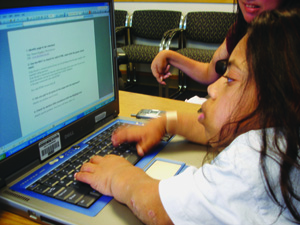
Disabilities include those that affect vision, speech, hearing, attention, learning, and mobility. Keep in mind, as suggested by the pictures in this publication, that many disabilities are not obvious to others. These "invisible disabilities" include learning disabilities, attention deficits, autism spectrum disorders, and psychiatric impairments.
This publication can help you take steps to make your project activities and resources accessible to individuals with disabilities. It was created in cooperation with attendees at the 2007 AccessSTEM Capacity-Building Institute (CBI) that included representatives from projects supported by the National Science Foundation (NSF) to increase the participation of women, minorities, and people with disabilities in science, technology, engineering, and mathematics (STEM) fields. Proceedings of the CBI are located at www.uw.edu/doit/cbi/bpstem/proceedings.html.
Steps Toward a More Accessible STEM Project
Addressing issues related to the following five topic areas provides a good starting point for making your facilities, information resources, and project activities universally accessible to people with and without disabilities.
PLANNING AND EVALUATION
Include people with disabilities—along with students who are diverse in race, ethnicity, gender, and age—in the project planning process. Consider partnering with an organization that has expertise in serving individuals with disabilities, such as a campus disability services office, when you write a grant proposal and implement a funded project.
INFORMATION RESOURCES
Ensure that publications and websites—through pictures and text—welcome a diverse group of prospective participants and that the content is accessible to people with a variety of abilities. For example, apply U.S. federal accessibility standards to ensure that your website is accessible to people who are blind and use speech synthesizers to read the content. Include a statement about how to request materials in alternate formats and disability-related accommodations.
PHYSICAL SPACES
Ensure physical access, comfort, and safety within environments that are welcoming to people with a variety of abilities, racial/ethnic backgrounds, genders, and ages. For example, make part of your desk at a height that is accessible from a seated position. Allow space for individuals using wheelchairs to comfortably view a presentation or participate in a science lab.
COMPUTERS, SOFTWARE, AND ASSISTIVE TECHNOLOGY
If computers are used in your project, make sure that the technology is accessible to all participants. Have available adjustable-height work tables, work space to accommodate left- and right-handed participants, and a system in place to ensure timely responses to requests for assistive technology.
INSTRUCTORS AND STAFF
Make sure staff members are prepared to work with all program participants and to arrange for disability-related accommodations when needed. Ensure that instructors can deliver presentations that are accessible to individuals with a variety of abilities. Strategies for applying universal design to instruction can be found at www.washington.edu/doit/equal-access-universal-design-instruction.
These examples are taken from the comprehensive online checklist in the publication Equal Access: Universal Design of Your Project at www.washington.edu/doit/equal-access-universal-design-your-project.
Accommodations and Universal Design
Most instructors, service providers, and project directors respond positively to a request for an accommodation so that a person with a disability can participate in activities or access resources. This reactive approach is appropriate for specialized services, like the provision of a sign language interpreter for a participant who is deaf. However, proactive steps can be taken to minimize the need for accommodations.
Universal design is a proactive approach to making physical spaces, information resources, instruction, and activities accessible to and usable by everyone. Universal design means that rather than designing for the average user, you design activities and resources for people with a broad range of characteristics with respect to age, native language, gender, race/ethnicity, learning style, interest, ability, and disability. Disabilities to consider include those that affect vision, speech, hearing, attention, learning, and mobility. Universal design of your project offerings makes everyone feel welcome and minimizes the need for accommodations for individual participants.
Anticipating the needs of people with disabilities and applying universal design concepts during the planning stages of your project activities and products will make these valuable resources more accessible to everyone.
Legal Issues
Section 504 of the Rehabilitation Act of 1973, the Americans with Disabilities Act of 1990, and the Americans with Disabilities Act Amendments of 2008 prohibit discrimination against individuals with disabilities. According to these laws, no otherwise qualified person with a disability shall, solely by reason of his/her disability, be excluded from the participation in, be denied the benefits of, or be subjected to discrimination under any program or activity of a public entity. This means that your project resources and activities should be accessible to qualified individuals with disabilities. Contact legal counsel at your institution or your regional Office for Civil Rights about legal mandates relevant to your project.
Benefits of Universal Design
Making your project welcoming and accessible to individuals with disabilities will benefit society by making STEM opportunities available to more citizens and enhancing STEM fields with the perspectives of people with disabilities.
Resources
Consult the following resources on universal design:
- CAST: Transforming education through Universal Design for Learning www.cast.org
- The Center for Universal Design www.design.ncsu.edu/cud
- The Center for Universal Design in Education www.washington.edu/doit/programs/center-universal-design-education/overview
AccessSTEM Knowledge Base
The searchable AccessSTEM Knowledge Base provides direction and resources for making all aspects of your project welcoming and accessible to participants with disabilities. This resource includes questions and answers, case studies, and promising practices and is located at www.washington.edu/doit/programs/accessstem/knowledge-base.
The Collaborative Dissemination Website
www.washington.edu/doit/programs/RDE
Past and current STEM projects that focus on individuals with disabilities act as a catalyst and resource for individual institutions and employers in their efforts to recruit and retain individuals with disabilities in STEM. Their replication models, curriculum materials, checklists, videos, and other products are available in a collaborative dissemination website and shared in a searchable Knowledge Base. Materials on the website serve to increase awareness of how people with disabilities can be successful in STEM as well as how other programs can make their web and print resources, courses, worksites, and activities more welcoming and accessible to people with disabilities.
Acknowledgment
The Alliance for Students with Disabilities in Science, Technology, Engineering, and Mathematics (AccessSTEM) is directed by DO-IT (Disabilities, Opportunities, Internetworking, and Technology) and funded by the NSF's Research in Disabilities Education program (cooperative agreement #HRD-227995 and award #HRD-833504). Any opinions, findings, conclusions, or recommendations expressed in this publication are those of the authors and do not necessarily reflect the views of the NSF.
© 2013, 2010, 2007 AccessSTEM, University of Washington. Permission is granted to copy these materials for noncommercial purposes provided the source is acknowledged.